
How Manufacturers Derive Value with Data Platforms
Breaking down IIoT silos, standardising shop-floor telemetry into governed data products, and scaling AI beyond isolated pilot projects.

Last updated on 20th August, 2026
TL;DR
- The Core Bottleneck: Manufacturing data isn't lacking, it's severely fragmented across SCADA, MES, historians, and ERP systems, forcing teams to waste time reconciling records rather than improving throughput.
- The High-Velocity Challenge: IIoT telemetry streams millions of signals per hour. Legacy lakes either drop critical context or drown teams in noise, causing industrial AI pilots to stall.
- The Data Product Paradigm: Shifting to a data product strategy transforms raw shop-floor inputs into governed, reusable, and interoperable operational assets equipped with built-in metadata, SLAs, and access controls.
- Measurable ROI: Unifying operational data delivers higher line throughput, reduced unplanned downtime, lower scrap rates, automated compliance tracking, and friction-free data sharing with supply chain partners.
Manufacturers are under pressure to modernise faster than ever. Supply chains are volatile, production lines are heavily instrumented, and customers expect better quality, faster delivery, and full transparency. Yet most manufacturers still can't turn their data into operational advantage.The problem is fragmentation. Sensor data, production metrics, quality logs, and supply-chain signals live in separate systems, arriving too late and in formats that don't connect.
Teams spend more time reconciling data than improving throughput or reducing downtime. AI pilots stay disconnected because the underlying data is incomplete, inconsistent, or siloed.The bottleneck is infrastructure. Without a consistent way to collect, structure, and share data across the value chain, analytics doesn't scale, decisions can't be automated, and AI stays a pilot forever.
This is where data platforms change the equation, giving manufacturers a single operational backbone that integrates data from machines, processes, and partners; standardises it through governance; and makes it available across engineering, operations, quality, and supply chain. Data stops being an IT problem and becomes a shared capability.
[playbook]
The Data Challenges in the Manufacturing Sector
Manufacturing has always been data-heavy, but the way data is created today is fundamentally different, faster, more fragmented, and embedded across machines, suppliers, and workflows.
Most manufacturers aren’t struggling because they lack advanced analytics tools. They’re struggling because their operational reality has shifted in ways their systems weren’t built to support.
Data exists, but it’s trapped in operational silos
Production lines run on SCADA, MES, PLCs, historians, vendor-specific equipment logs, and semi-manual spreadsheets. None of these systems speaks the same language. Even basic questions, 'Why did throughput drop yesterday?, Which machine is trending toward failure?,' take human stitching to answer.
As a result, every improvement initiative begins with a data-gathering exercise, and not problem-solving.
High-frequency machine data overwhelms traditional architectures
IIoT devices stream millions of data points per hour. Traditional data lakes weren’t designed for this level of velocity and granularity. Manufacturers either store too little (losing context) or store too much (creating noise).
Without a modern data platform, the cost and complexity of handling real-time operational data become a barrier to AI adoption.
Data quality degrades as it moves across the value chain

Quality metrics recorded on the shop floor don’t match ERP codes. Supplier data arrives incomplete. Maintenance logs vary by technician. Each handoff introduces inconsistencies that a model can’t reconcile.
This fragmentation makes cross-value-chain optimisation, the actual source of big ROI, nearly impossible.
[related-1]
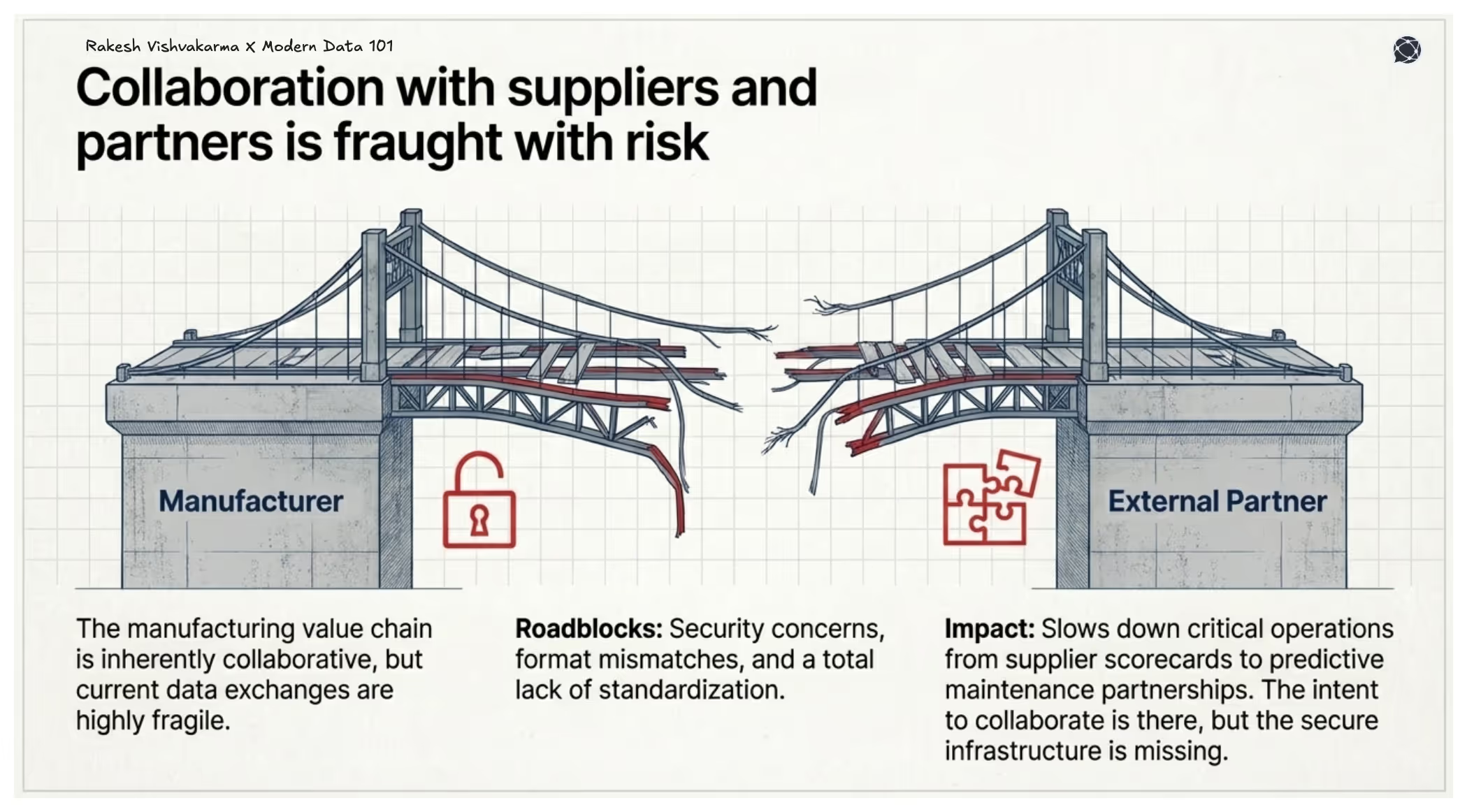
Data sharing with suppliers and partners is risky and inconsistent
The manufacturing value chain is collaborative, but data exchanges are fragile. Security concerns, format mismatches, and lack of standardisation slow down everything from supplier scorecards to predictive maintenance partnerships.
Manufacturers want to collaborate, but they lack an infrastructure that makes data sharing safe and repeatable.
Governance and compliance remain manual and plant-specific
Traceability, audit readiness, and quality compliance are still manual processes in many environments. Paper trails, spreadsheets, and local SOPs are all disjointed.
As operations digitise, this governance model becomes a bottleneck. Another new dashboard, or even point tools and solutions, are incompetent in solving these deep, structural issues created by the way manufacturing data is born, stored, and used today.
[data-expert]
Turning data into profit generators for manufacturers
As manufacturers are deployed on an enormous volume of operational data, it is crucial to treat them in a strategic manner.
In most manufacturing units or enterprises, data is still captured for reporting or compliance. The opportunity is simple: when manufacturers can consistently transform raw operational data into reliable, contextualised, and reusable assets, that data becomes a direct profit generator. It fuels predictive maintenance, quality optimisation, scheduling automation, and supply chain collaboration, use cases that deliver measurable impact on cost, uptime, and yield.
The challenge is the lack of a system that turns fragmented data into something usable across teams and workflows. This is where the shift toward a data product approach becomes essential.
[related-2]
How Does a Data Platform Enable Manufacturers to Optimise Their Business Operations?
Think of a data platform strategy that treats data as a product to ensure improved business operations.
That's onboarding a data product platform.
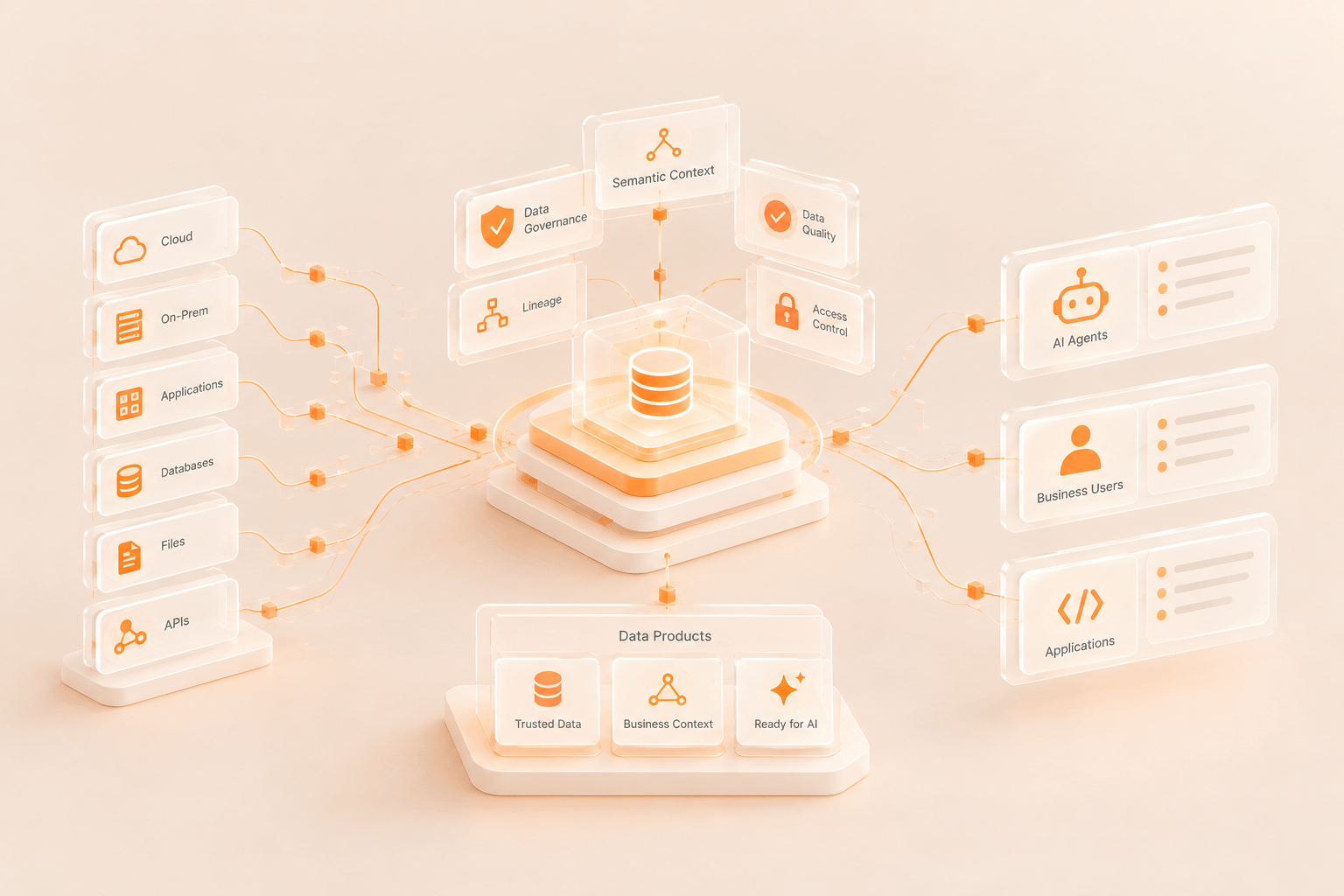
A Data Product Platform is a unified system that transforms raw, fragmented operational data into governed, reusable, and interoperable Data Products. It provides the self-service infrastructure teams need to reliably use data across analytics, AI, and core manufacturing workflows. By serving as a unified, self-service layer where every dataset becomes a governed, reusable, interoperable product that can be reliably consumed by analytics, operations, and AI, this platform will enable manufacturing enterprises to treat data as an operational asset, and not an IT artefact.
.avif)
Converting raw operational data into governed Data Products
Instead of leaving sensor data, MES logs, quality checks, or supplier inputs in their native silos, the platform converts each into a Data Product with built-in metadata and context, quality rules, lineage tracking, and access policies.
This removes the need for manual reconciliation and creates a standard format that every team, and every model can trust.
Creating a single interoperability layer across the plant
The platform sits between operational systems (PLC, SCADA, historians), enterprise tools (ERP, QMS, EAM), and advanced analytics or AI workloads.
It normalises and connects data from all sources, so manufacturing teams don’t have to engineer custom integrations for every use case. This is what allows predictive maintenance, real-time monitoring, and optimisation models to run reliably across lines and sites.
How Data Platforms Benefit Manufacturers with a Data Product Approach?
When manufacturers unlock productivity, resilience, and competitive advantage across the value chain, they do so by making data consistent, governed, and reusable.
- Higher Throughput and Lower Downtime
Unifying machine, maintenance, and sensor data enables earlier anomaly detection and smarter line optimisation. Impact? Fewer unplanned stoppages and improved production stability.
- Better Quality and Reduced Scrap
Linking quality data with process parameters supports predictive quality and faster root-cause analysis. This results in reduced defects, lower scrap, and higher yield per line.
- Improved Real-Time Operational Visibility
With a data product platform, integrating MES, ERP, and other historian systems into a single view drives situational awareness, making it easier and more effective, enabling faster coordination, clearer bottlenecks, and more efficient scheduling.
- Accelerated AI and Automation Deployment
Model-ready Data Products eliminate the need to rebuild pipelines for each AI initiative. The result? A quicker time-to-value and fewer model failures in production.
- Better Collaboration Across the Value Chain
Governed data-sharing enables manufacturers, suppliers, and OEMs to align on shared insights. This helps improve supplier performance, more accurate forecasts, and tighter customer partnerships.
- More Reliable, Consistent Decision-Making
A single source of truth removes dependency on spreadsheets and plant-level data inconsistencies, enabling consistent and contextualised data-driven decisions.
[related-3]
How Can We Reduce Operational Costs for Manufacturers?
When operational data is unified and reliable, manufacturers can finally see where inefficiencies originate and fix them before they turn into losses. Predictive insights reduce unnecessary maintenance, early-warning signals prevent waste and rework, and workflow automation cuts down manual effort across engineering, quality, and operations.
The impact: Sustained reductions in waste, energy consumption, and maintenance spend, translating into measurable margin expansion across every product line.
Laying a Foundation for Next-Gen Manufacturing (AI, Digital Twins, Autonomy)
.avif)
Modern manufacturing depends on data platforms that can feed real-time models, digital twins, and autonomous workflows. The path to next-gen manufacturing is paved with platform readiness. Once the data foundation is stable, manufacturers can layer on advanced capabilities: real-time optimisation, intelligent scheduling, adaptive control systems, and cross-plant coordination, with far less friction.
Conclusion
Manufacturing's next competitive frontier will be won in the data layer beneath it. The manufacturers who pull ahead will be those who stop treating data as a byproduct of operations and start treating it as the raw material for every decision, every model, and every improvement initiative. A Data Product Platform serves as the bridge addressing the fragmented stack, turning isolated machine signals, quality logs, and supplier inputs into a shared operational language that teams can trust and systems can act on. The result is compounding: every governed data product built today becomes the foundation for faster AI deployment, better yield, fewer stoppages, and tighter collaboration tomorrow.The question for manufacturers is no longer whether to invest in a data foundation. It's how quickly they can build one before the gap between them and data-mature competitors becomes too wide to close.
FAQs
Q1. How are manufacturing companies valued?
Manufacturers are valued using EBITDA multiples, discounted cash flow, and asset-based checks. Key drivers: capacity utilisation, margin stability, capex needs, and customer concentration. Leveraging efficient data product platforms adds to operational efficiency and scalable processes, often raising valuations more than sheer production volume.
Q2. How can manufacturers unlock value from data sharing?
Manufacturers can unlock value from data sharing by joining secure ecosystems, standardising data, and exchanging only what drives mutual gain. Start with clear use cases (predictive quality, shared logistics), govern IP rigorously, and use neutral platforms so partners trust the flow of high-value insights.
Q3. How Manufacturers use data to drive value?
Manufacturers turn real-time production, quality, and supply-chain data into value by predicting failures, optimising throughput, reducing waste, and automating decisions. Unified data models and closed-loop analytics connect machines, people, and workflows to lift performance end-to-end.
Connect with a community data expert
A no-cost session with a practitioner who's been where you are.
About Modern Data 101
Modern Data 101 is a movement redefining how the world thinks about data. A community built by the same team behind the world’s first data operating system, Modern Data 101 sits at the intersection of data, product thinking, and AI. Spread across 150+ countries, the community brings together a global network of practitioners, architects, and leaders who are actively building the next generation of data systems.
At its core, Modern Data 101 exists to simplify the journey from raw data to tangible and observable impact. It advocates high-potential data systems and next-gen architectures to unify and activate insights and automation across analytics, applications, and operational workflows at the edge.
In a world shifting from data stacks to AI ecosystems, Modern Data 101 helps teams not just navigate the change but lead it.


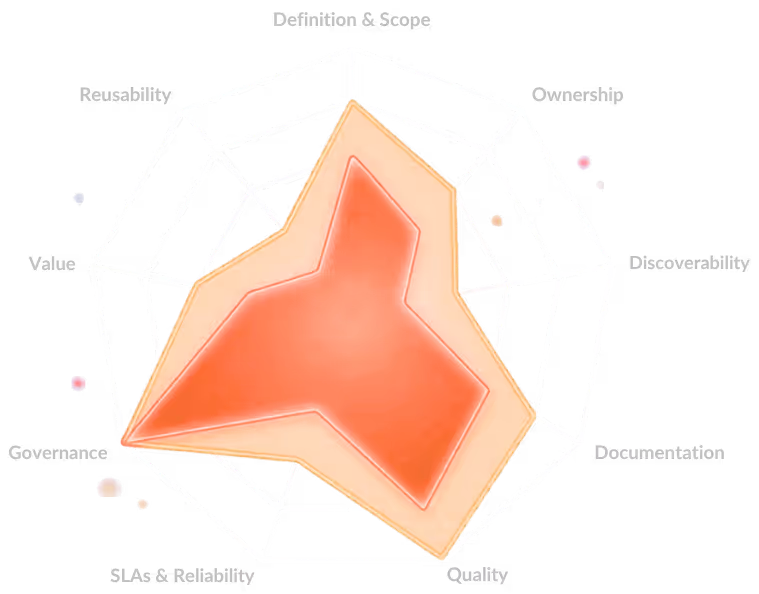
Where does your org stand on data product maturity?
A 9-dimension self-assessment used by 100+ data teams to benchmark strategy, ownership, and platform readiness.


Rakesh Vishvakarma
Rakesh is a data engineer who transforms raw data into fine wine. When he's not using AI to tag tables or make spot-on recommendations, he's deep into philosophical books or ones with more twists than his latest ETL pipeline, pondering existence and data governance.
Read the ideas here. Build them with The Modern Data Company.
Modern Data 101 is where the data community thinks out loud. When you're ready to move from articles to architecture, data products, governed AI pipelines, or a full Data Operating System; the team behind this community can help you build it.
Continue reading


.jpg)
