How to Sell & Monetise Data
A product thinking approach to selling and monetising data for greater business impact with easy data buyer-seller relationships.

For a long time, data was treated as exhaust, generated as a side effect of running the business, stored “just in case,” and rarely owned with intent. That mental model no longer holds.
Today, data is recognised as a business asset. When data is reliable, well-governed, and contextualised, it moves from background noise to strategic leverage.
This shift points to the growing focus on questions like how to sell data or how to monetise a database. Organisations are realising that value doesn’t come only from internal use. It can also come from sharing data externally, through partnerships, marketplaces, and data-selling platforms that match supply with demand.
[state-of-data-products]
As data marketplaces mature and privacy and consent standards strengthen, selling data is becoming a deliberate, repeatable capability built on product thinking.
[related-1]
What Is Data Monetisation?
Data monetisation is the process of converting data into measurable economic value through internal optimisation or external revenue streams, which allows treating data as a product and extracting commercial benefit or direct business value from it.
This improves processes to reduce costs or, more directly, sell data and data-powered insights to external buyers, creating new offerings, or licensing access on data-selling platforms and marketplaces. Effective data monetisation focuses on providing packaged data that includes quality, context, and governance so that it delivers value buyers are willing to pay for.
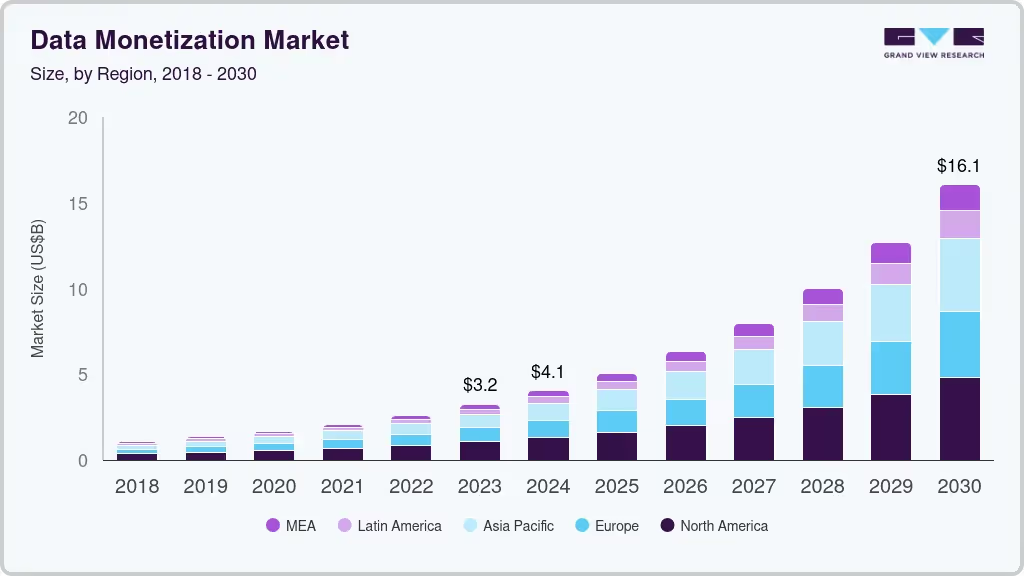
Challenges of Data Monetisation
In multiple scenarios, data monetisation fails because of how data is treated within the organisation. Most data isn’t product-ready. Instead, it’s fragmented across domains, poorly documented, inconsistently defined, and hard to trust. Without strong metadata, lineage, and quality signals, data is complex to package and even harder to sell.
Figuring out the right strategy
Often, platforms are chosen before the right strategy is in place. Data marketplaces and APIs simplify distribution, but they do not define a monetisation strategy. Enterprises need an alignment between domains, data products, and market demand; organisations end up listing data instead of selling value.
Establishing the data governance requirements
External data or data asset buyers don’t accept ambiguity in terms of quality, like missing metadata, inconsistent definitions, unclear lineage, and stale data, which erodes customer trust, revealing quality gaps previously hidden.
Now let’s consider governance. Many teams approach monetisation before solving consent, access control, anonymisation, and policy enforcement. Governance added late becomes friction. Governance designed into data products becomes a differentiator. The challenge isn’t regulation, it’s sequencing and mindset.
Identifying the correct data to be monetised
An article titled ‘The Problem with Data Monetisation’ points out how not all data has monetisation value. The biggest challenge is figuring out whether the data reduces uncertainty for a buyer and whether it’s hard (or expensive) to replicate. Data that only mildly informs decisions or can be easily recreated internally will struggle to be monetised successfully.
How to Monetise Data? The Different Monetisation Models
Conventional methods of selling and monetising data are primarily two:
Selling Raw Data
One of the most straightforward methods of selling data is offering datasets through direct downloads or subscription-based access on data-selling platforms and marketplaces. This works best when the data is well-structured, consistently refreshed, and aligned to a specific use case.
Buyers need to understand what the data represents, how it can be used, and how often it updates. This requires efficient documentation, metadata, and governance to avoid the raw data from becoming a liability. As a result, this model is typically suited for mature data producers with high-quality, repeatable datasets.
Selling Data Insights and Services
This model moves up the value chain by selling outcomes instead of inputs. Rather than exposing raw data, organisations package insights, analytics reports, dashboards, or predictive services that solve a defined problem. For example, a churn prediction service or demand forecast is easier to consume and easier to price than a raw customer table. While this approach requires stronger analytics and domain expertise, it delivers higher margins, more evident differentiation, and stronger buyer trust.
Selling Data Products
Data products are built with purpose and business outcomes in mind that render value aligned with revenue goals. This enables organisations to package data with logic, context, and guarantees, making it directly consumable by external users.
Consider having a demand forecasting data product, built internally to optimise inventory and supply planning. Over time, it matures: definitions stabilise, models improve, and trust is established. That same product can be offered externally as a forecasting service for suppliers or partners, delivered via APIs, dashboards, or subscriptions. So buyers pay for reduced uncertainty and faster decisions.
[data-expert]
This shift, from datasets to products, changes the monetisation conversation. Data products themselves can become the revenue drivers because they deliver complete, consumable capabilities to external customers, delivering a repeatable capability that someone else finds valuable enough to pay for.
[related-2]
Choosing the Right Data Selling Platforms and Channels
The data-selling platform an enterprise chooses determines how its data products are discovered, consumed, governed, and valued. Selling data products starts by defining the consumption model, not by listing the asset.
Some products are built for discovery and reuse; others are for continuous or programmatic access. When the channel does not match the consumption pattern, friction follows.
While multiple channels exist, data marketplaces are best suited for selling data products. They are designed for self-service discovery, reuse, and governance at scale, amplifying adoption, trust, and revenue.
[related-3]
Data Marketplaces for Data Monetisation
One of the most significant barriers to adoption is discoverability and ease of use; data products must be easy to find, evaluate, and consume for users to extract value.
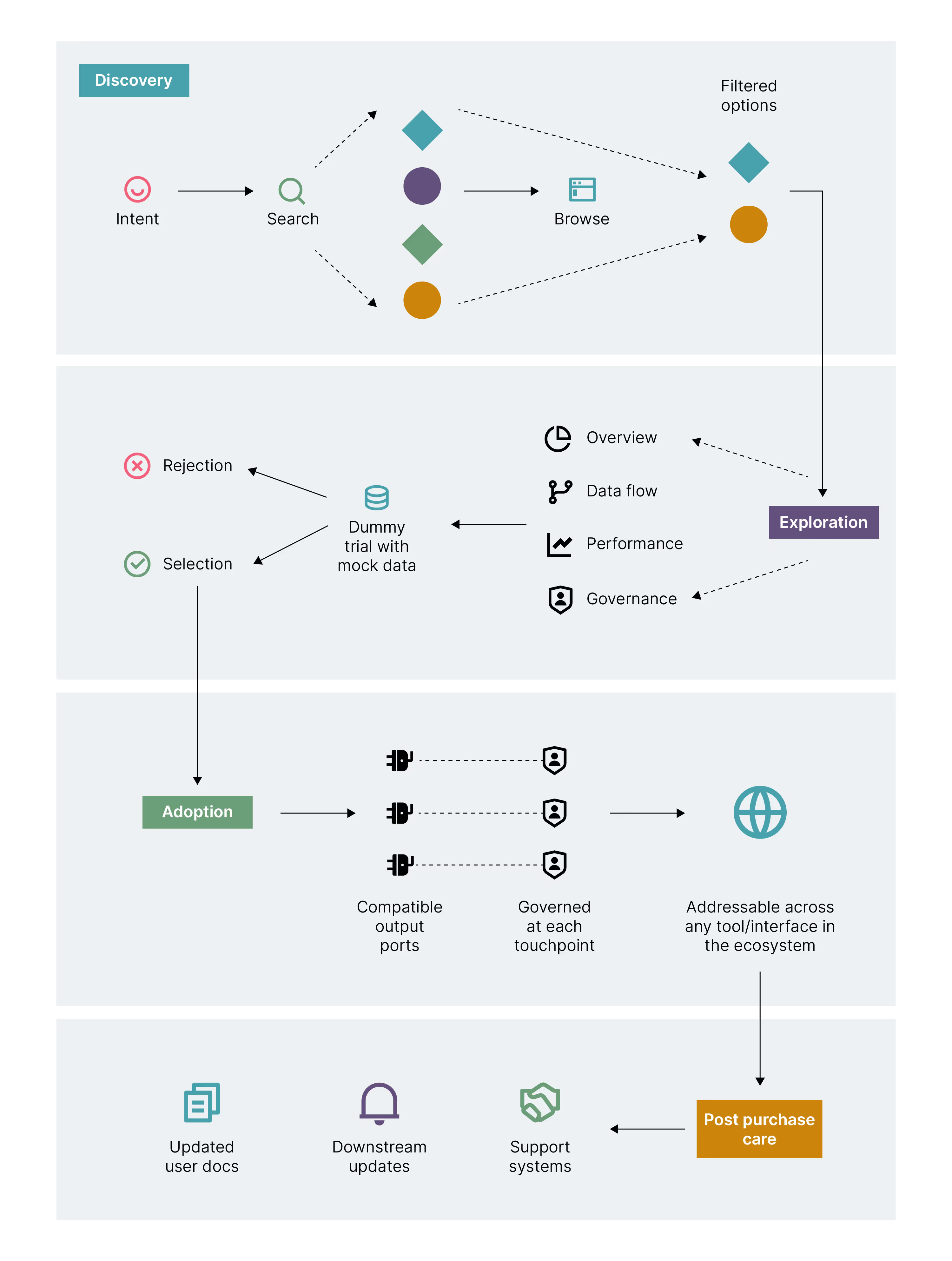
A good marketplace experience reduces friction in the adoption journey. By exposing rich metadata, governance context, service-level indicators, and lineage, users are equipped to assess fit and risk confidently, lowering barriers to purchase and integration.
So, how is a data marketplace suitable for monetising data and data products?
- Marketplaces turn discovery into a first-class capability, which is a prerequisite for any commercial exchange.
- Exposed metadata, lineage, and SLAs reduce the perceived risk of adoption, exactly what buyers need before paying for a data product.
- Marketplaces standardise evaluation and access, making selling repeatable rather than one-off.
- A data product that is easy to consume is more likely to be reused. Reuse creates demand signals, which make pricing, licensing, and monetisation viable.
FAQs
Q1. What is the difference between Direct vs. Indirect Monetisation?
Direct monetisation generates revenue by selling data or data products outright, through marketplaces, subscriptions, or pay-per-use models. Whereas, Indirect monetisation creates value by using data to enhance other business outcomes, like improving products, personalising services, or driving operational efficiency, which in turn boosts revenue without selling the data itself.
Q2. How can I monetise my own data?
One can monetise their data by turning it into a usable, trustworthy data product and sharing it through the proper channels. This could be a data marketplace, a consumer-facing app, or an API for programmatic access. The focus is on packaging data with context, quality, and governance so that others can discover, trust, and consume it, then charging for access, usage, or insights.
Connect with a community data expert
A no-cost session with a practitioner who's been where you are.
About Modern Data 101
Modern Data 101 is a movement redefining how the world thinks about data. A community built by the same team behind the world’s first data operating system, Modern Data 101 sits at the intersection of data, product thinking, and AI. Spread across 150+ countries, the community brings together a global network of practitioners, architects, and leaders who are actively building the next generation of data systems.
At its core, Modern Data 101 exists to simplify the journey from raw data to tangible and observable impact. It advocates high-potential data systems and next-gen architectures to unify and activate insights and automation across analytics, applications, and operational workflows at the edge.
In a world shifting from data stacks to AI ecosystems, Modern Data 101 helps teams not just navigate the change but lead it.


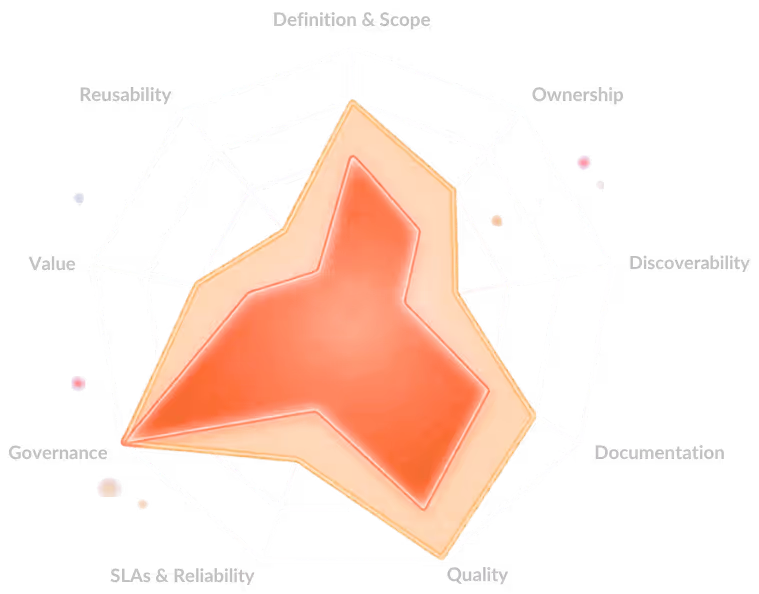
Where does your org stand on data product maturity?
A 9-dimension self-assessment used by 100+ data teams to benchmark strategy, ownership, and platform readiness.


Ritwika Chowdhury
Ritwika Chowdhury is a data and technology professional focused on data products, AI, and modern data architecture. Her work sits at the intersection of data strategy, product thinking, and emerging AI technologies, with a focus on helping organisations turn enterprise data into trusted, usable, and scalable assets.
Read the ideas here. Build them with The Modern Data Company.
Modern Data 101 is where the data community thinks out loud. When you're ready to move from articles to architecture, data products, governed AI pipelines, or a full Data Operating System; the team behind this community can help you build it.
Continue reading
.jpg)
.png)

.png)