How to Choose the Right AI Agent Architecture in 2026: An Enterprise Framework for Data Leaders
A definitive guide to sense-plan-act loops, Model Context Protocol (MCP), and selecting between custom builds and off-the-shelf agents.

TL;DR
- An AI agent perceives, plans, and acts toward a goal with limited human input, agentic AI adds autonomy and tool use on top of generative AI.
- Agents run a sense-plan-act loop, and the ones that hold up in production pair that loop with governed access to data and tools, instead of just a large context window.
- No-code platforms suit non-technical teams automating a defined process; open-source frameworks suit developers who want full control; enterprise platforms suit teams that need something production-ready fast.
- Match the agent type to task complexity, technical depth, and budget instead of comparing to whichever tool is trending.
- Most teams get more value learning how to use an existing agent well than building one from scratch; reserve custom builds for processes no off-the-shelf agent fits.
This guide breaks down what an AI agent actually is, how agents work under the hood, and how to match the right type to your use case, whether you’re picking a tool off the shelf or learning how to build AI agents from scratch.
[report-2025]
What Is an AI Agent
An AI agent is a software system that perceives its environment, plans a course of action, and executes tasks toward a goal with limited human intervention. Unlike a static script, it adapts its next move based on what it observes. Most agents combine four building blocks: perception (reading inputs like text, files, or APIs), reasoning (deciding what to do), tool use (calling external systems), and memory (retaining context across steps). This is the core of what agentic AI is: autonomy layered on top of a reasoning engine, instead of a chat window that replies once and forgets.
Is Agentic AI Generative AI
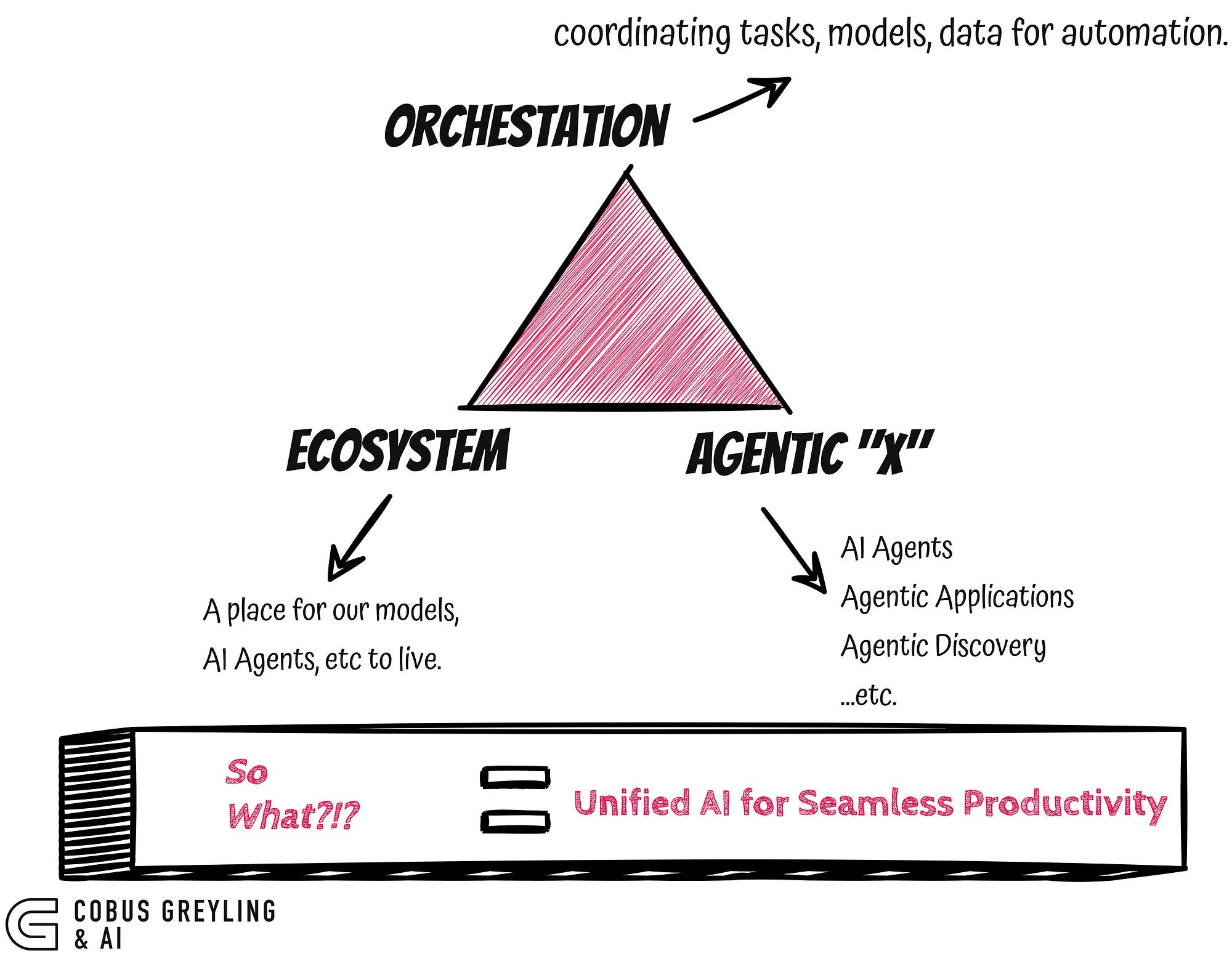
Not exactly, though the two are closely related. Generative AI produces content, text, code, images, in response to a single prompt. Agentic AI goes further: it strings together multiple generative and non-generative steps, calls tools, checks its own output, and decides what to do next without a person prompting each step. Put simply, generative AI answers; agentic AI acts. Most AI agents are built on generative models, especially large language models, but the agent layer is what adds planning, memory, and tool orchestration on top.
[playbook]
How Do AI Agents Work
Every agent runs some version of a sense-plan-act loop. First, it takes in a goal and relevant context. Second, it breaks that goal into steps and decides which tools or data sources it needs. Third, it acts, querying a database, sending an email, writing code, and checks the result before deciding whether to continue or adjust. Governed agent stacks add a layer where agents need controlled, well-documented access to the systems they act on in place of just a big context window.
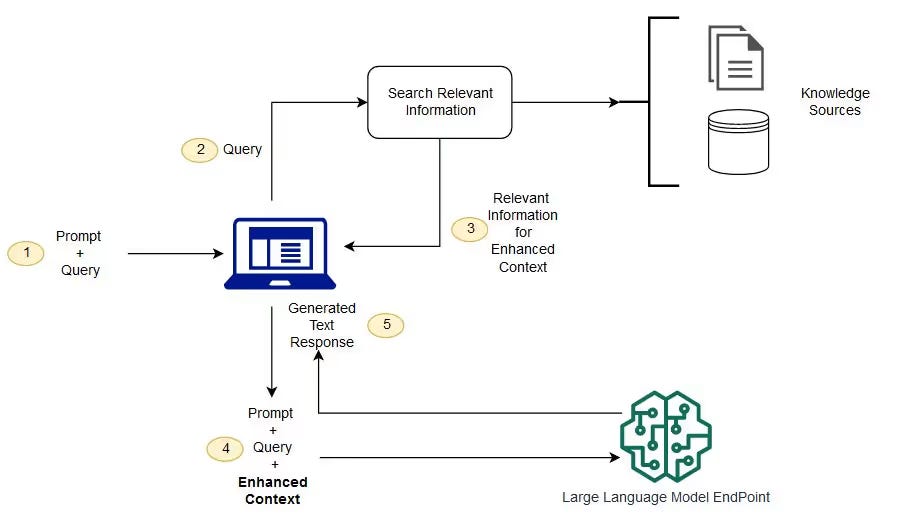
That’s why frameworks like the Model Context Protocol are becoming central to how enterprise agents query data with awareness of lineage and permissions through their agentic infrastructure. Without that governance layer, autonomy itself becomes a risk, since an ungoverned agent can act across systems with little oversight.
[related-1]
Which AI Agent Type Suits You Best?
There’s no universal winner; the right pick depends on three factors:
- your task complexity,
- your team’s coding comfort, and
- how much control you need over cost and data.
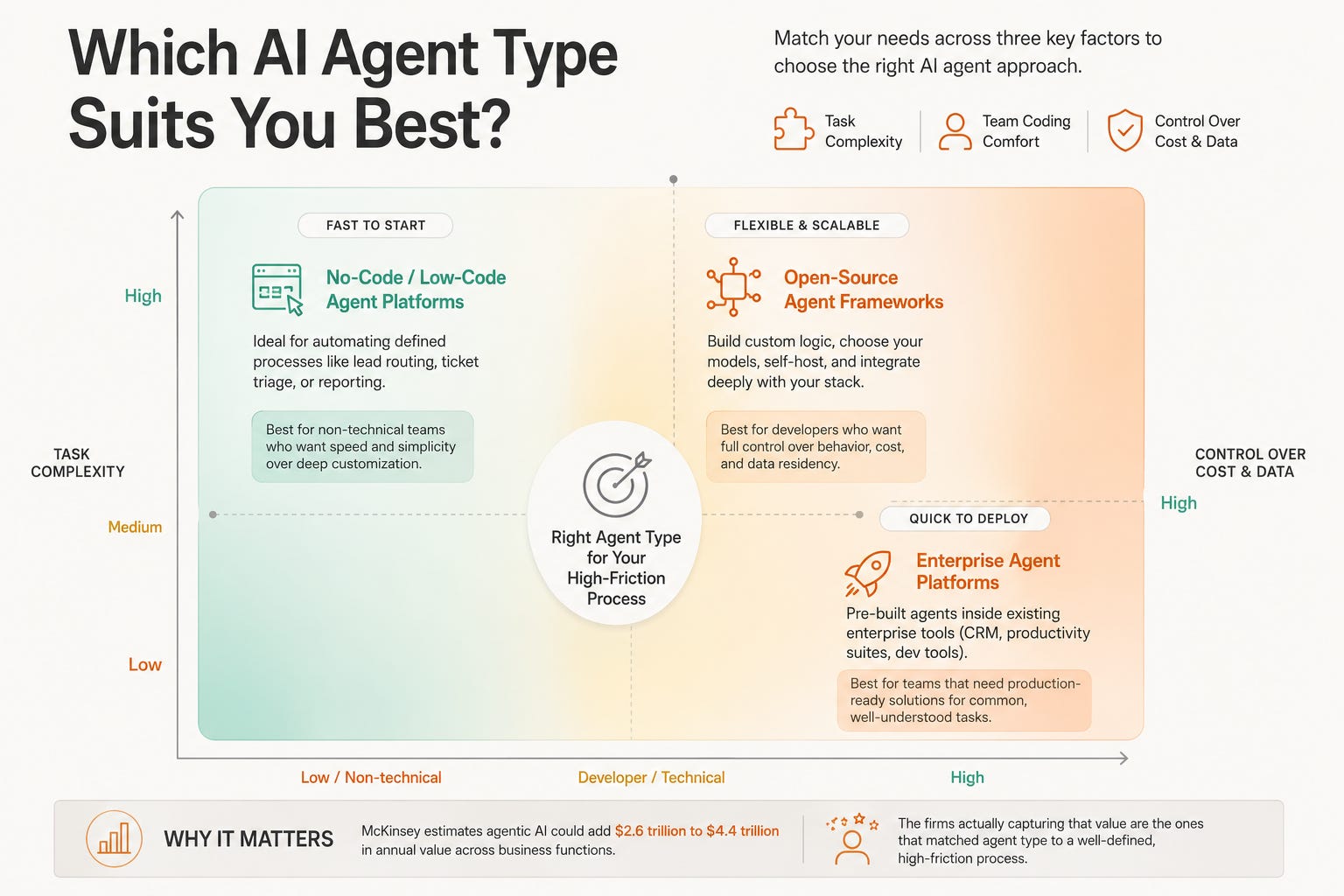
If you want to use AI agents without writing code
No-code and low-code platforms (workflow builders and visual agent designers) are the fastest way to automate a defined process, think lead routing, ticket triage, or scheduled reporting. They trade some flexibility for speed of setup, and they’re the right starting point if your team is largely non-technical.
If you’re a developer who wants full control
Open-source agent frameworks let you write the logic yourself, choose your own models, and self-host if data residency matters. This path takes longer to ship but gives you the most control over cost, behaviour, and how agents plug into your existing stack.
If you need a production-ready solution fast
Enterprise agent platforms bundle pre-built agents into existing software (CRM, productivity suites, developer tools). They’re the quickest route to deployment for common, well-understood tasks, though you inherit that vendor’s ecosystem and pricing.
McKinsey estimates agentic AI could add $2.6 trillion to $4.4 trillion in annual value across business functions, but the firms actually capturing that value are the ones that matched agent type to a well-defined, high-friction process.
Why Data Platforms Matter for Building AI Agents
If you’re evaluating how to build agentic AI in-house, start narrow: pick one repetitive, rules-heavy process, define success criteria, and give the agent access to only the tools and trusted data sources it needs for that task.
[related-2]
Building an agent generally involves choosing a base model, defining its available tools, connecting it to the data platform that provides governed, contextual access to enterprise data, adding memory so it retains context across steps, and wrapping the whole thing in guardrails that limit what actions it can take without a human check-in. For most teams, though, learning how to use AI agents that already exist, rather than building one from zero, is the faster path to value. Reserve custom builds for processes specific enough that no off-the-shelf agent fits.
[related-3]
Strategic Takeaway: Mapping Your First High-Impact AI Agent Process
Before you commit to a platform, map the process you want to automate, note where it currently breaks down, and use that as your test case. For a closer look at how governed data access shapes what agents can safely do, follow our space.
FAQs
Q1. Which AI agent is best for what?
There's no single best agent, the right one tracks the job. Coding work leans toward Claude Code, Cursor, or Codex; workflow automation toward no-code builders like n8n or Zapier Agents. It is important to match the category to the task before comparing brands within it.
Q2. How to decide which AI agent to use?
Start with three questions: How complex and how repeatable is the task? How much coding capacity does your team have? And how much control do you need over cost, data residency, and governance? A well-defined, high-friction process with a non-technical team usually points to a no-code or enterprise platform; a process needing tight control over data and behaviour points to an open-source framework.
Q3. Which AI coding agents are teams using right now?
As of mid-2026, the tools showing up most often in developer comparisons are Claude Code, Cursor, OpenAI’s Codex, GitHub Copilot, and open-source options like OpenCode and Cline. The category has converged on the idea that the “harness” around a model- how it plans, uses tools, and runs tests- now matters as much as the underlying model itself, so the right pick depends on whether a team wants terminal-based control, an AI-native IDE, or the widest existing install base.
Q4. What’s the best AI agent tool in 2026?
There isn’t one tool that leads across every category. The market has split by function instead of consolidating around a winner. Coding agents, workflow-automation platforms, customer-support agents, and enterprise-knowledge agents are each led by different tools, and enterprise buyers increasingly evaluate on governance and lifecycle management, not just raw capability. Picking “the best” agent tool starts with picking the category that matches the problem, then comparing options inside it.
Connect with a community data expert
A no-cost session with a practitioner who's been where you are.
About Modern Data 101
Modern Data 101 is a movement redefining how the world thinks about data. A community built by the same team behind the world’s first data operating system, Modern Data 101 sits at the intersection of data, product thinking, and AI. Spread across 150+ countries, the community brings together a global network of practitioners, architects, and leaders who are actively building the next generation of data systems.
At its core, Modern Data 101 exists to simplify the journey from raw data to tangible and observable impact. It advocates high-potential data systems and next-gen architectures to unify and activate insights and automation across analytics, applications, and operational workflows at the edge.
In a world shifting from data stacks to AI ecosystems, Modern Data 101 helps teams not just navigate the change but lead it.


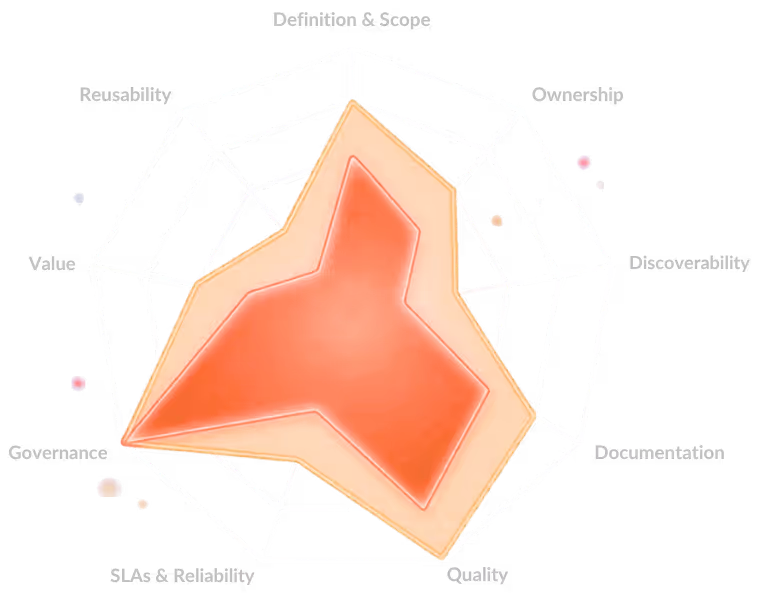
A 9-dimension self-assessment used by 100+ data teams to benchmark strategy, ownership, and platform readiness.


Akshay Chame
Akshay is a GenAI/ML engineer building production-grade AI systems, including RAG pipelines, AI agents, MCP servers, and LLM fine-tuning. An IEEE-published researcher and Smart India Hackathon 2023 winner, he is focused on scalable, reliable AI systems that move intelligent solutions from experimentation to production.

Ritwika Chowdhury
Ritwika Chowdhury is a data and technology professional focused on data products, AI, and modern data architecture. Her work sits at the intersection of data strategy, product thinking, and emerging AI technologies, with a focus on helping organisations turn enterprise data into trusted, usable, and scalable assets.
Read the ideas here. Build them with The Modern Data Company.
Modern Data 101 is where the data community thinks out loud. When you're ready to move from articles to architecture, data products, governed AI pipelines, or a full Data Operating System; the team behind this community can help you build it.
Continue reading
.png)