Conceptual vs. Logical vs. Physical: Choosing the Right Data Model for Business Outcomes
Logic Over Legacy: Why skipping to physical modelling is killing your data strategy and how to fix it with ERD design.

Conceptual, logical, and physical models are not competing artefacts but different lenses on the same reality, each optimised for a different outcome.
- The conceptual model is about meaning: how the business thinks, speaks, and reasons about the world.
- The logical model is about structure: how those meanings relate, constrain, and scale without yet committing to technology.
- The physical model is about execution: how those structures survive gravity, like performance, cost, storage, and compute.
Choosing the wrong layer for the problem you’re solving is how teams end up arguing SQL when they should be debating semantics, or debating semantics when the real constraint is latency.
Data modelling isn’t a mandatory art project designed to justify an architect’s salary. If you think an Entity Relationship Diagram (ERD) is just a collection of boxes and lines to be filed away as “documentation,” you’ve already failed. At its core, data modelling is the act of giving data shape and constraints so it becomes reliable reasoning material. It is the literal bridge between a business’s messy reality and the rigid constraints of a high-performance system.
A data product is a reusable, measurable asset engineered with the discipline of product thinking. To build one, you must come to the understanding that you are designing for the truth. A Logical Data Model is that blueprint of your company’s intelligence.
And to build a system that scales, you must navigate three distinct layers of abstraction: The Conceptual, The Logical, and The Physical. Each serves a specific outcome, and confusing them is how you end up with expensive databases that nobody knows how to query.
[state-of-data-products]
Why Data Models Exist: Outcomes Over Diagrams
Data models exist for one reason: to ensure your data actually means something. They are tools for alignment, scale, and correctness. In the modern landscape, we are moving away from centralised monoliths toward decentralised domains where teams own their data. In this world, models are built around value streams instead of just storage preferences.
The most common failure in modern data teams is choosing the wrong model at the wrong time.
If you’re arguing about data types (physical) before you’ve defined what a “customer” actually is (conceptual), you are building a high-speed engine for a car that doesn’t have a steering wheel. You’ll get somewhere fast, but it won’t be where the business needs to go.
Conceptual vs. Logical vs. Physical Data Models: What’s the Difference
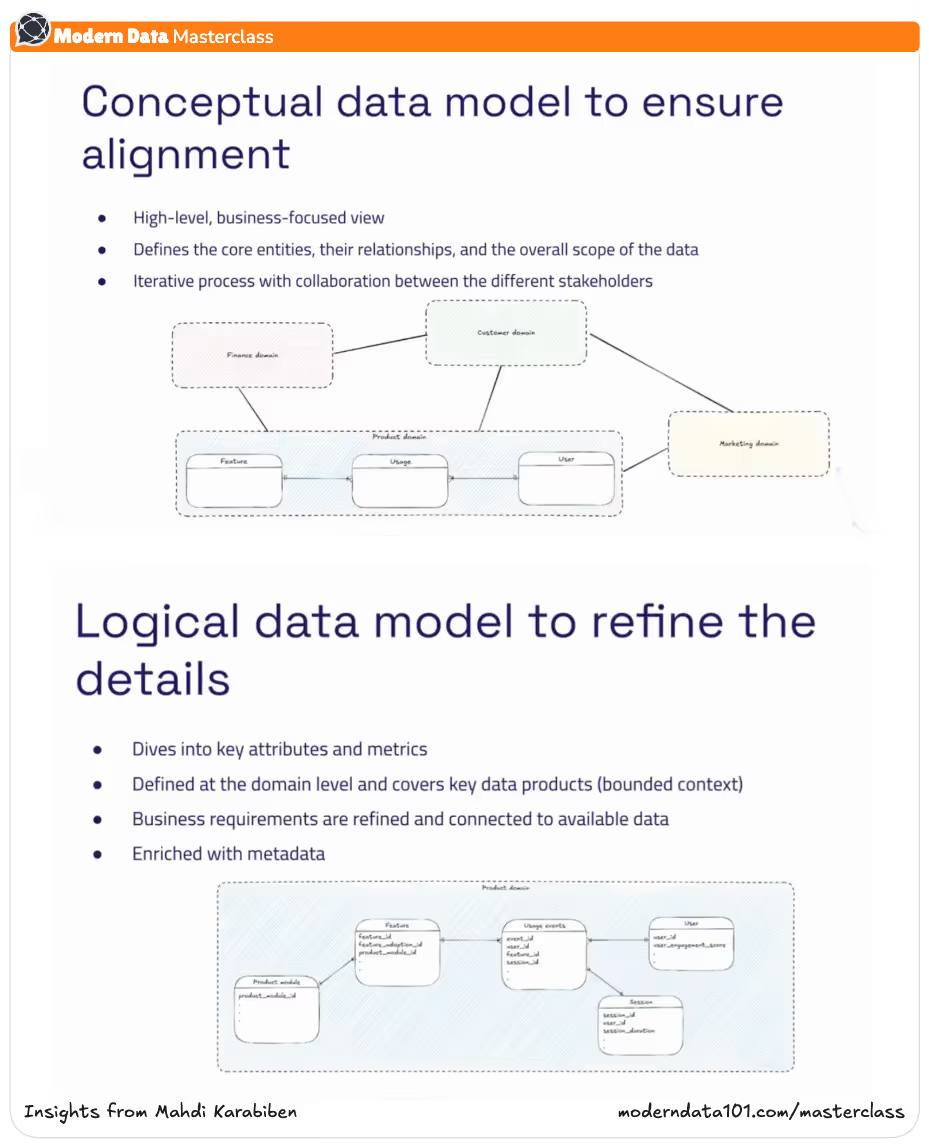
What is a Conceptual Data Model
Conceptual data modelling pertains to defining the business language. The Conceptual Model is the “What.” It is the pure, unfiltered language of the business.
At this stage, jargon like “primary keys” or “varchar” has no place. You are defining entities and the high-level relationships between them.
Does an “Order” belong to a “Customer” or a “Household”? This is where the foundation for your Entity Relationship Diagram begins. This stage demands conversations, not code. If you can’t explain your data in plain English at the conceptual level, you have no business trying to code it.
What is a Logical Data Model
Logical data modelling means to structure business meaning without technology. The logical model is where the heavy lifting of ERD design happens.
In a logical model, we are able to define your attributes, keys, and relationships while staying platform-agnostic. The logical database model doesn’t care if you’re using a cloud database, a relational one or even a graph database. All it cares about are the rules of your business universe.
This is the most critical layer for modern organisations because this is where the Semantic Layer is born. A Logical Data Model further allows you to expand into “Metric Trees.” It’s the source of truth that prevents data silos. If you get the Logical Model right, your technology choices become interchangeable.
What is a Physical Data Model
A Physical Data Model optimises for storage and performance. The Physical Model is the “How,” and becomes the execution artefact.
The physical data model is where we talk about tables, indexes, partitions, and constraints. It’s tuned for the machine instead of the human. The physical layer succeeds when it remains porous and interoperable, allowing different domains to talk to each other without breaking trust. If the conceptual and logical models are the strategy, the physical model is the tactical execution.
When to Use Which Data Model (And When Not To)
When aligning stakeholders, use conceptual data models: If you’re in a boardroom, do not show them a schema. Show them a conceptual map of their business entities and value streams.
When designing analytics, AI, and Data Products, use logical data models: This is your semantic foundation. If you want AI agents to understand your data without hallucinating, they need the structured context of a Logical Data Model.
When it’s time to implement, use physical data models: This is for the data engineers. It’s the final step in turning a bulletproof business requirement into a functional, high-performance database.
What breaks when teams skip straight to physical modelling?
Everything. When you skip the logical phase, you bake your business rules directly into your hardware. The moment the business changes, your entire system shatters because there is no separation between the “Meaning” of the data and the “Storage” of the data.
Why AI and analytics fail without a strong logical model
AI requires context. If your data is just a pile of physical tables with cryptic names, your AI is flying blind. An Entity Relationship Diagram rooted in a strong Logical Model provides the map that AI needs to navigate your data with accuracy and avoid the “safe bet fallacy” of ad-hoc pipelines.
[playbook]
How Entity Relationship Diagrams (ERDs) Evolve
An Entity Relationship Diagram is not a static picture but is the evolution from language to logic. It starts as high-level bubbles in a conceptual meeting and matures into a detailed Logical Data Model full of formal definitions and rules of engagement.
The industry has confused “drawing ERDs” with ERD design. Anyone can put boxes on a screen. True design is about the cardinalities and the business constraints that make data valid. Your ERDs are most valuable at the logical layer because that is where you finalise the “Laws of the Data” even before the first table is ever created.
How to Choose the Right Data Model for a Required Business Outcome
- Start with the outcome: What is the specific business decision, metric, or product feature this data must support?
- Identify core entities (Conceptual): Define the “What” in plain English. Ensure all stakeholders, from Marketing to Finance speaks the same vocabulary.
- Normalise meaning and rules (Logical): Define the attributes and keys. Map out your Metric Trees.
- Validate with use cases: Does this shiny new model back your AI goals and analytical scenarios? If not, now is the time to fix it.
- Translate to physical schema: Finalise the blueprint by agreeing on business rules first, then build the actual database to ensure your technology serves your strategy, not the other way around.
- Iterate as outcomes evolve: Your model isn’t a monument that you create once in a lifetime. Treat it like a living engine that evolves as the business creates new value.
Stop letting your database dictate your business rules. Start with intent, solidify the logic, and only then worry about the physical implementation. That is how you build an architecture that stands the test of time.
Connect with a community data expert
A no-cost session with a practitioner who's been where you are.
About Modern Data 101
Modern Data 101 is a movement redefining how the world thinks about data. A community built by the same team behind the world’s first data operating system, Modern Data 101 sits at the intersection of data, product thinking, and AI. Spread across 150+ countries, the community brings together a global network of practitioners, architects, and leaders who are actively building the next generation of data systems.
At its core, Modern Data 101 exists to simplify the journey from raw data to tangible and observable impact. It advocates high-potential data systems and next-gen architectures to unify and activate insights and automation across analytics, applications, and operational workflows at the edge.
In a world shifting from data stacks to AI ecosystems, Modern Data 101 helps teams not just navigate the change but lead it.


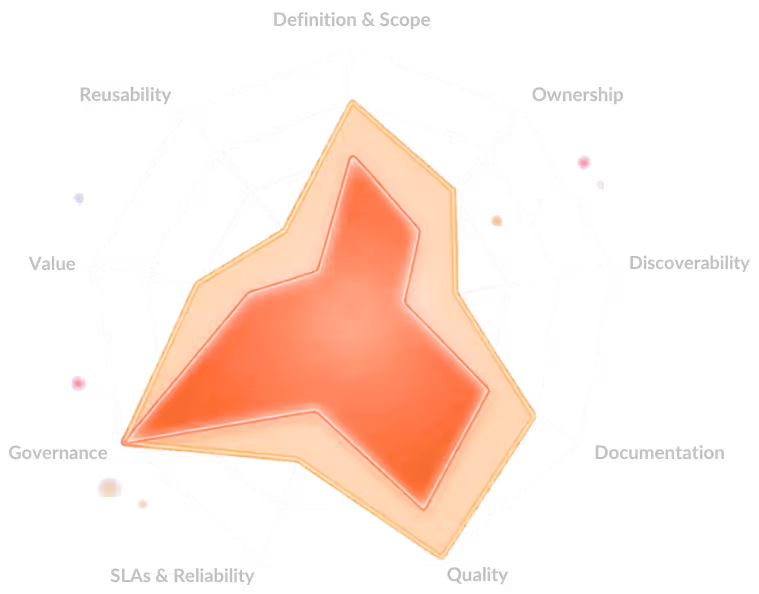
Where does your org stand on data product maturity?
A 9-dimension self-assessment used by 100+ data teams to benchmark strategy, ownership, and platform readiness.


Swami Achari
Swami Achari is a Lead Tech Correspondent and Content Strategist who loves translating complex Data, Engineering, and AI concepts into compelling, high-impact stories. Grounded in a strong background in mainstream journalism, he seamlessly bridges traditional investigative reporting with cutting-edge technology communication. Currently exploring editorial strategy and content marketing for data-focused platforms, he works closely with industry thought leaders to build engaged tech communities and foster strategic growth through scannable, audience-first storytelling.
Read the ideas here. Build them with The Modern Data Company.
Modern Data 101 is where the data community thinks out loud. When you're ready to move from articles to architecture, data products, governed AI pipelines, or a full Data Operating System; the team behind this community can help you build it.
Continue reading