Agent Harness Failures vs Context Failures: Why AI Agents Need a Governed Data Layer
Runtime checks validate the call, but only a governed data layer provides truth. Learn the 5 entry points of context failure in enterprise agents.


of organisations report risky agent behaviour
of senior AI executives whose firms use agents cannot detect unauthorised agents operating internally
of banks name data readiness and access as the top barrier to agent deployment
of executives trust agents with data analysis

An agent harness can pass every check and still deliver a wrong answer. The loop ran, the tool call validated, the permission held, the action was logged, and the figure the agent reported came from a column nobody had certified. That is a context failure, and it is the failure harness engineering was never designed to catch. In our survey of, 73% discover after the fact that the data behind a decision was wrong or outdated.
What an Agent Harness Does
An agent harness is everything around the model: the loop, the tools, the memory, the permissions and the checks that decide how an AI agent acts. Harness engineering has matured fast because harness failures are visible. A missing stop condition produces a runaway loop, a broken tool produces an error, and a cost spike gets noticed. The team running the agent harness finds these quickly and fixes them.
[playbook]
Harness Failures and Context Failures Are Different Problems
A harness failure is a failure of control. A context failure is a failure of knowledge: the agent behaves exactly as designed, on information that was stale, conflicting, unapproved or never intended to be used. Context failures are silent by construction, because the agent harness validated the call, checked the permission and logged the action. 80% of organisations report risky agent behaviour, including improper data exposure, and 26% of senior AI executives whose firms use agents cannot detect unauthorised agents operating internally. These are systems that worked and were wrong.
Why an Agent Harness Cannot Catch a Context Failure
Every control loop needs a reference to compare outputs against. In software, a test suite provides one, so a harness knows when a coding agent is wrong. Enterprise agents rarely have a test suite. When an agent reports revenue, nothing in the agent harness can say whether the figure is the governed metric, whether the account is the right customer, or whether the policy applied is current. The harness verifies form, and truth is a property of the data. An agent harness can make an agent reliably wrong.
[report-card]
Five Places a Context Failure Enters the Agent Loop
Context failures enter at five stages of the loop. At perceive, the agent retrieves from an unapproved source because it ranked best on similarity. At interpret, two definitions or two customer records reach the model, and it guesses. At decide, a constraint that lives in policy never reaches the context. At act, an authorised call returns records the acting identity should not use. At remember, a summarised fact outlives the record it described.
Context rot, the degradation from lost-in-the-middle and attention dilution, is a separate assembly failure that harness engineering can fix on its own. The five above are supply failures, and only the data layer can fix them.
[dpma]
Confidence Is Outrunning the Data
Governance confidence is rising faster than data readiness. 73% of leaders express confidence in their governance, while 80% of banks name data readiness and access as the top barrier to agent deployment. Spend follows the visible layer: 70% of organisations run AI monitoring dashboards, and every one of those sits at the agent harness. Trust is highest where context failures hide best, with 38% of executives trusting agents with data analysis against 20% for financial transactions. A wrong analysis looks like an analysis.
What a Governed Data Layer Gives the Agent Harness
A governed data layer supplies three signals the agent harness cannot generate for itself. The first is reference: certified metrics, versioned definitions and resolved entities, the enterprise equivalent of a test suite. The second is measurement: freshness, source authority and lineage attached to every input. The third is limits: classification, purpose-based entitlement and permitted actions enforced at the data, where a prompt cannot leave them out.
The practical test is simple. Can an agent ask for “revenue” and receive either the certified metric with its freshness and lineage, or an explicit statement that none exists?
How to Tell Which Failure You Have
Run a swap test. Replace the context for a failing task with a hand-verified one and rerun it. If the failure disappears, it is a context failure. If it persists, swap in a minimal reference agent harness. If it disappears now, it is a harness failure.
Then close the ownership gap. Harness teams report that every call succeeded, and data teams report that the source was correct. Both are right, and the answer is still wrong. Naming one accountable owner for what enters an agent’s context window closes the seam between them. Harness engineering made agents reliable. It cannot make them right. That difference is a data problem, and a governed data layer is how enterprises solve it.
This article summarises findings from Modern Data 101’s full research brief, Harness Failures and Context Failures: Why Agents Need a Governed Data Layer.
Get the full report
- 16-page downloadable report
- Designed for data and AI leaders
- Offers insights on addressing challenges for agent harness
Get the full report
- 16-page downloadable report
- Designed for data and AI leaders
- Offers insights on addressing challenges for agent harness


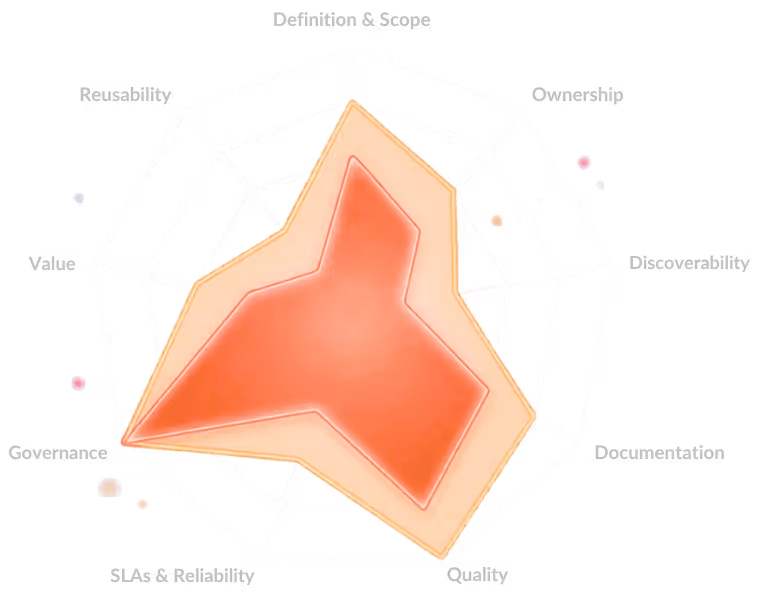
Where does your org stand on data product maturity?
A 9-dimension self-assessment used by 100+ data teams to benchmark strategy, ownership, and platform readiness.

You're all set
Your report is opening in a new tab
Tab didn't open? Open it manually
Akshay Chame
Akshay is a GenAI/ML engineer building production-grade AI systems, including RAG pipelines, AI agents, MCP servers, and LLM fine-tuning. An IEEE-published researcher and Smart India Hackathon 2023 winner, he is focused on scalable, reliable AI systems that move intelligent solutions from experimentation to production.
Ritwika Chowdhury
Ritwika Chowdhury is a data and technology professional focused on data products, AI, and modern data architecture. Her work sits at the intersection of data strategy, product thinking, and emerging AI technologies, with a focus on helping organisations turn enterprise data into trusted, usable, and scalable assets.
Why AI Agents Need a Governed Data Layer
- 16-page downloadable report
- Designed for data and AI leaders
- Offers insights on addressing challenges for agent harness
You're all set
Your report is opening in a new tab
Tab didn't open? Open it manually
You're subscribed
You'll get every new Modern Data Report in your inbox — check your email to confirm.
Done