What Is a Forward Deployed Engineer? How FDEs Bridge the Enterprise AI Conversion Gap
88% of enterprises use AI, yet only 39% see EBIT impact. Discover why OpenAI, AWS, and Microsoft bet billions on FDEs, and how a governed data layer captures their work.

say their data is not clean or trustworthy enough for AI
of organisations use AI regularly
believe that AI is deeply transforming their business
of net dollar retention of 165% shows what embedded engineers do for account expansion

- While 88% of companies use AI, only 39% report EBIT impact and 56% of CEOs see zero cost or revenue gains. Forward deployed engineers close this gap by embedding inside customer environments with end-to-end accountability for taking AI into production.
- Major labs and hyperscalers poured billions into FDE teams in 2026, including OpenAI ($4B+), Microsoft ($2.5B / 6,000 specialists), and AWS ($1B), driven by commercial models like Palantir’s 165% net dollar retention.
- FDEs perform five core tasks: making data usable, aligning business definitions, connecting systems, validating agent behaviour, and transferring learning, compensating for missing data-layer capabilities.
- Every FDE engagement uncovers critical business definitions, cleaned pipelines, and access rules. If enterprises fail to capture this “residue” in a shared platform, they pay to rediscover the exact same context on every subsequent project.
- Platforms like DataOS institutionalise FDE discoveries through a universal semantic layer, automated governance, and reusable data products, shrinking integration timelines so engineers can focus on workflow redesign rather than manual data repair.
Most companies have bought the data platform, the models and the agents, and still cannot make them work together. In our survey of 540+ practitioners, almost 70% say their data is not clean or trustworthy enough for AI, and 73% discover after the fact that the data behind a decision was wrong or outdated. The role built to close that gap is the forward deployed engineer, and in 2026 it moved from a Palantir speciality to an industry structure.
What Is a Forward Deployed Engineer?
A forward deployed engineer, or FDE, works inside one customer’s environment, builds against its real systems and data, and stays accountable until the solution runs in production. Palantir drew the clearest distinction: a regular developer builds one capability for many customers, while an FDE builds many capabilities for one customer. The AI variant connects a model to the customer’s data, builds the evaluations that show an agent behaves, and wires in authentication and logging. The test that separates a forward deployed engineer from a consultant or solutions engineer is simple: who is accountable on the day the system goes live?
Why Data and AI Investments Fail to Convert
The gap between AI spend and AI value is a conversion gap. 88% of organisations use AI regularly, yet only 39% report any EBIT impact at the enterprise level. Among CEOs, 56% report neither higher revenue nor lower cost from AI, and only 25% believe that AI is deeply transforming their business, while cost is the primary barrier for 40%. Money reached the tools. It did not reach the joints between them: data and definitions, models and systems, agents and people.
Why 2026 Made the Forward Deployed Engineer Mainstream
OpenAI launched its Deployment Company with over $4 billion and about 150 FDEs from Tomoro. AWS committed $1 billion to its own FDE organisation, and Microsoft followed with $2.5 billion and 6,000 specialists. Anthropic funded a $100 million academy for engineers who can take AI into production. The logic is commercial. Palantir’s net dollar retention of 165% shows what embedded engineers do for account expansion. Deloitte and EY have launched FDE roles of their own, so labs and consultancies now compete for the same work.
What Forward Deployed Engineers Do: Human Middleware
Strip away the title and an FDE does five jobs: making data usable, making meaning shared, making systems connect, making behaviour trustworthy, and making learning travel. Each compensates for something the data layer cannot yet do, which is why we call the pattern human middleware. An engineer embedded in a messy data estate spends the first weeks reconciling definitions and repairing pipelines, work a governed data layer should do automatically. In our survey, 80% rank a semantic layer with standardised definitions as the top AI enabler for the same reason.
Solving the Residue Problem: Capturing Discovered Context Before FDEs Leave
Every FDE engagement produces a deployment and a residue of discovered context: the definitions agreed, the data repaired and the access rules mapped. The deployment serves one team. The residue can serve every later team, if someone captures it. Skills make this urgent. Insufficient worker skills are the biggest barrier to integrating AI, yet 53% respond with workforce education and only 36% hire specialised talent. Talent that scarce cannot be the scaling mechanism, so each engagement has to leave assets that make the next one cheaper.
FDE ROI Framework: Where Embedded Engineers Pay Back (and Where They Fail)
Forward deployed engineers pay back where integration complexity, context specificity and value at stake overlap, and where the problem has an owner and an internal team will inherit the system. They return little on standardised processes, or when the organisation is still choosing which problems matter, where an embedded engineer becomes expensive staff augmentation. Embedded engineers are also privileged identities inside sensitive data estates, so they need the same least-privilege access and audit trail as agents.
How a Governed Data Layer Changes the Work
On a platform built around governed data products, an FDE’s early weeks shrink. DataOS, built by The Modern Data Company, layers over an existing stack, carries meaning in a universal semantic layer, enforces access through its Heimdall governance engine, exposes products through MCP, and lists certified status, quality signals and ownership in its Data Product Hub. The engineer expresses a definition or an access rule once, and the platform enforces it. What remains is workflow redesign, evaluation and adoption. Platform speed claims deserve testing in a bounded engagement, and a data product layer captures residue only when teams publish to it.
The forward deployed engineer is a transitional role that matters while the data layer catches up. Enterprises that capture residue will need fewer FDEs per deployment each year. Enterprises that do not will keep paying for the same discovery.
This article summarises findings from Modern Data 101’s research brief, ‘What Is a Forward Deployed Engineer? How FDEs Bridge the Enterprise AI Conversion Gap.’
Get the full report
Get the full report


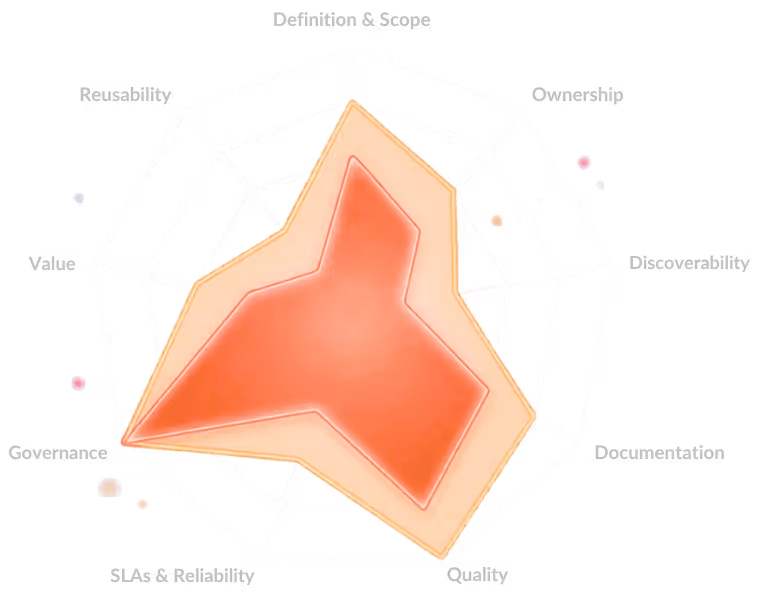
Where does your org stand on data product maturity?
A 9-dimension self-assessment used by 100+ data teams to benchmark strategy, ownership, and platform readiness.


You're all set
Your report is opening in a new tab
Tab didn't open? Open it manually
Ritwika Chowdhury
Ritwika Chowdhury is a data and technology professional focused on data products, AI, and modern data architecture. Her work sits at the intersection of data strategy, product thinking, and emerging AI technologies, with a focus on helping organisations turn enterprise data into trusted, usable, and scalable assets.
FDEs address the gap in AI investments
You're all set
Your report is opening in a new tab
Tab didn't open? Open it manually
You're subscribed
You'll get every new Modern Data Report in your inbox — check your email to confirm.
Done