Beyond AI Tooling: Building the Enterprise Enabling Layer for AI-Native Process Redesign
From task-level productivity to end-to-end process logic: Architecting the AI-native enterprise.



of organisations use AI at a surface level
report the most mature state of AI
organisations using agentic AI cannot detect unauthorized AI agents operating internally
use AI for automated data preparation

- 74% of all financial value from AI is captured by a narrow 20% of organizations. The difference isn't model quality, but whether AI is embedded into end-to-end process logic or restricted to isolated point tools.
- Point solutions optimize individual tasks in silos (e.g., summarizing an invoice without visibility into open disputes or supplier contract changes). Consequently, only 39% of organizations attribute measurable EBIT impact to AI.
- True AI-native transformation requires a unified substrate:
- Data Products with Contracts: Clean, reliable data foundations (addressing the 68% data reliability gap).
- Semantic Context Layer: Shared business definitions accessible to human analysts and AI agents.
- Process & Agent Orchestration: Workflow engines that manage autonomous execution across handoffs.
- Continuous Feedback Loops: Systematic optimization derived from real-world outcome data.
- Governed Decision Records: Complete auditability to eliminate orphaned automation (where 26% of companies operate unauthorized internal agents).
- Test one high-value, cross-functional process across five criteria; context, signal, decision, action, and learning. A process is only AI-native when all five links connect within a single governed feedback loop.
Most large organisations now use AI somewhere in their business, yet few have changed how their core processes are designed, governed, and improved. Deloitte’s 2026 State of AI in the Enterprise survey finds that 30% of organisations are redesigning key processes around AI, and a further 37% report using AI at a surface level, with little or no change to their underlying processes.
The gap shows up in the economics. PwC’s 2026 AI Performance Study finds that 74% of AI’s economic value is captured by 20% of organisations. The leaders are not necessarily using better models. They are doing something different around them.
AI-native is the level of digital transformation where AI becomes part of end-to-end process logic, spanning strategy, management, operations, control, and improvement. Reaching that level requires more than adding tools.
Why Too Many Tools Stall AI-Native Processes
Tools optimise individual tasks, and task gains are easy to report. McKinsey’s 2025 State of AI survey finds that only 39% of respondents attribute any EBIT impact to AI. High performers are nearly three times as likely to fundamentally redesign their workflows.
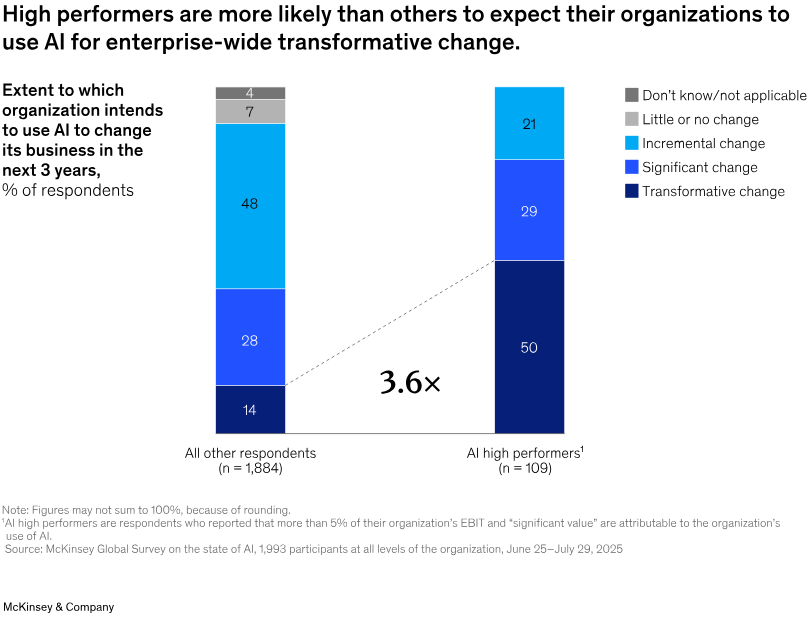
Tools also fail to share context. An AI feature inside one application can summarise an invoice, but it may not see that the same supplier has an open dispute, a delayed shipment, and a renegotiated contract elsewhere. The data underneath is often unready as well. In the Modern Data Report 2026, 68% of respondents say their data is not clean or reliable enough for AI use cases.
The 5-Part Enabling Layer: Architecting the AI-Native Infrastructure
We argue that the missing piece is an enabling layer with five components: data products with contracts, a semantic context layer, process and agent orchestration, a feedback and improvement loop, and governance with decision records.
These components work as a chain. Shared context makes signals interpretable. Timely signals support decisions. Recorded decisions can be learned from. A failure at one link becomes bad input for the next, which is why strong models and monitoring tools often produce little change. The chain breaks at a handoff.
Managing AI Agent Risk & Accountability
Governance is where the risk concentrates. EY’s 2026 AI Risk and Governance Survey finds that 26% of respondents whose organisations use agentic AI cannot detect unauthorised agents operating internally. We call this orphaned automation: automation that runs without a named owner for its results or its exceptions.
Process Redesign Roadmap: Evaluating the 5 Links of AI-Native Execution
Choose one process with cross-functional handoffs and a measurable outcome, then ask five questions. Do all steps read the same definition of the entities they handle? Does the process detect change in time to act? Is each decision recorded with its inputs and approver? Are the limits on autonomous action defined? Do outcomes flow back into the process design? A process qualifies as AI-native only when all five links connect within one governed cycle.
Organisational readiness matters as much as technology. McKinsey’s three horizons research finds that 13% of leaders in the enablement horizon report meaningful enterprise value from AI, compared with 48% in the reinvention horizon.
The more useful question for leaders is which business outcomes deserve redesign, which shared capabilities will enable that redesign, and how successful implementations can become reusable parts of the enterprise.
Frequently Asked Questions
What is AI-native transformation?
It is the stage where AI becomes part of end-to-end process logic, rather than a set of separate tools. Lysenko (2026) describes it as an integrative level of digital transformation that connects strategy, management, operations, control, and improvement.
Why do AI initiatives stall at the tool layer?
Tools improve individual tasks, but the process design, shared data context, and governance around them usually stay unchanged. The gains therefore rarely reach business outcomes.
What is the enabling layer?
It is the set of components that connects AI to a process: data products with contracts, a semantic context layer, process and agent orchestration, feedback loops, and governance with decision records.
How can an organisation test whether a process is AI-native?
Score five links (context, signal, decision, action, and learning) as absent, partial, or connected. The process qualifies only when all five are connected within one governed cycle.
Where should an organisation start?
Start with one process that has a measurable outcome and cross-functional handoffs. Measure process change rather than licence counts, then extend the shared components to neighbouring processes.
Get the full report
- 19-page downloadable report
- Explores why enterprise AI initiatives stall at the tool layer
- Provides strategic roadmap for AI-native business transformation.
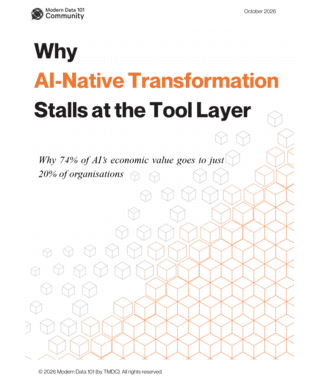
Get the full report
- 19-page downloadable report
- Explores why enterprise AI initiatives stall at the tool layer
- Provides strategic roadmap for AI-native business transformation.


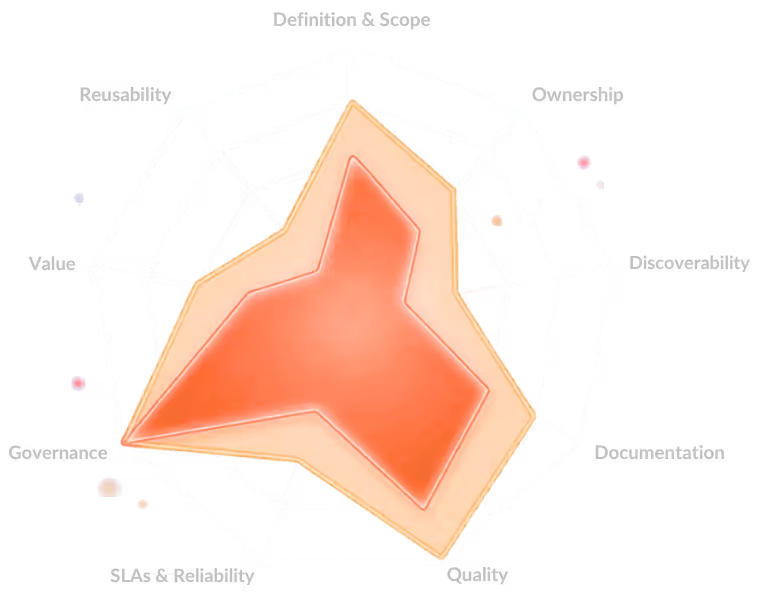
Where does your org stand on data product maturity?
A 9-dimension self-assessment used by 100+ data teams to benchmark strategy, ownership, and platform readiness.

You're all set
Your report is opening in a new tab
Tab didn't open? Open it manually
Soumadip De
Soumadip De is an AI Product Manager at The Modern Data Company, working on ontology, context management, and knowledge systems for enterprise AI agents. His work spans data-productisation, context mining, and agentic workflow enablement that help teams move from raw enterprise data to reliable answers and governed action.
Akshay Chame
Akshay is a GenAI/ML engineer building production-grade AI systems, including RAG pipelines, AI agents, MCP servers, and LLM fine-tuning. An IEEE-published researcher and Smart India Hackathon 2023 winner, he is focused on scalable, reliable AI systems that move intelligent solutions from experimentation to production.
Ritwika Chowdhury
Ritwika Chowdhury is a data and technology professional focused on data products, AI, and modern data architecture. Her work sits at the intersection of data strategy, product thinking, and emerging AI technologies, with a focus on helping organisations turn enterprise data into trusted, usable, and scalable assets.
Why AI-Native Transformation Stalls at the Tool Layer
- 19-page downloadable report
- Explores why enterprise AI initiatives stall at the tool layer
- Provides strategic roadmap for AI-native business transformation.
You're all set
Your report is opening in a new tab
Tab didn't open? Open it manually
You're subscribed
You'll get every new Modern Data Report in your inbox — check your email to confirm.
Done