Bringing Home Your Very First Data Product
From Logical Modeling and Product Ideation to Data Product Improvement

We want to partake in the data as a product experience (also focusing on product mindset), and in that pursuit, we need to define our first data product. To do so, we need to meet several prerequisites:
- Understanding the topology of data domains.
- Identifying the potential data owners affected.
- Familiarity with the data model.
For the sake of discussion on building data products (our first one), let's consider ourselves as the data owners of all the data we will use, based on the following logical data model for the Customer Domain for our enterprise (called ACME):

Now, let's consider our physical data model, which consists of three distinct data assets inside our Data System (it could be a DWH, a Data Platform or whatever). Two relational tables ("CustomerTable" and "AddressTable") that explicitly express the many-to-many relationship through a simple foreign key, and a topic “AddressQueue” that encapsulates address change information (for simplicity, let's assume the schema perfectly overlaps with the "AddressTable" table). In this case, we have the following representation (note: in real life, it would be slightly different, but I've simplified it for illustrative purposes):

💡 Data Product Ideation
Assuming that our first data product aims to publish a comprehensive version of the customer base along with their addresses. At this point, someone should have already defined the structure of the data contract, which should include at least the following information:
- Name: The name of the data product.
- Data Asset: Identification of the specific data assets involved, such as CustomerTable, AddressTable, etc.
- Data Content: Description of the content included in the data product, which in this case would be the complete customer base along with their addresses.
- Quality Assurance: Procedures and standards for ensuring the quality and accuracy of the data.
- Sensitivity: This includes assessing the Maturity Level, Reliability, and Trustworthiness of the data product.
- SLA (Service Level Agreement): Agreed-upon performance metrics and commitments regarding data availability, reliability, and other service aspects.
- Support and Contact Information: Details of who to contact for support, including contact methods and availability.
- Data Delivery: Specifications regarding how the data will be delivered, whether it's through a file transfer, API, database access, etc.
- Data Usage: Guidelines and restrictions on how the data can be used, ensuring compliance with legal and regulatory requirements.
Step 0️: Design Information.
In the process of building a data product, the data product owner should identify the basic information needed to satisfy a business need, whether it be for publication/sharing (data product source aligned) or for solving a specific use case (data product consumer aligned).
Together with any supporting figures (data owner, data steward, and so on), they should be able to complete the initial sections of the data contract, such as the name, classification, and necessary assets.
For our first iteration, let's consider we want to publish customer registry information with addresses without any logic other than the mere publication on our marketplace (or data mesh registry). In this way, the first version of the data contract for the 'Customer Registry' product would be as follows:
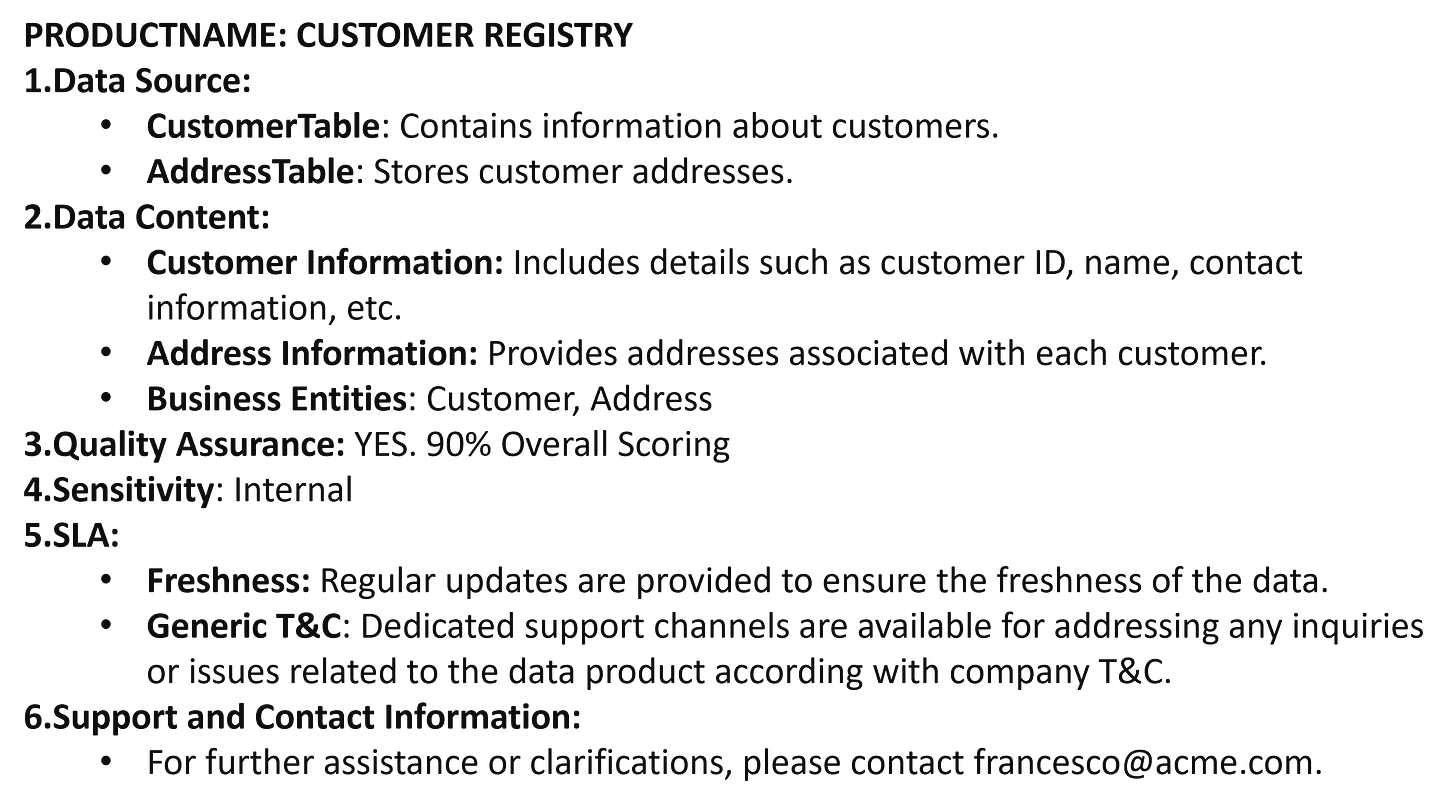
There are some fields that are important to focus on in the initial stage of building a data product. The "Data Content: Business Entities" field should refer to the taxonomy (the list of business terms in simple terms) of our data catalog. This is one of the cornerstones that enables subsequent semantic interoperability because it ensures two effects:
- It supports in identifying the data owners involved in any certification processes.
- It enables the possibility of search and cataloging.
Then there is the "Quality Assurance" field, which is actually a separate section as it involves integration with the data quality engine, the exposure of scores, and their weighting (data veracity paradigm).
The absence of these fields is limiting because it does not allow for the management of interoperability and the evaluation of the contextualization of the reliability degree of the data product.
📝 Note from Editor:
Step 1️: Design the Access
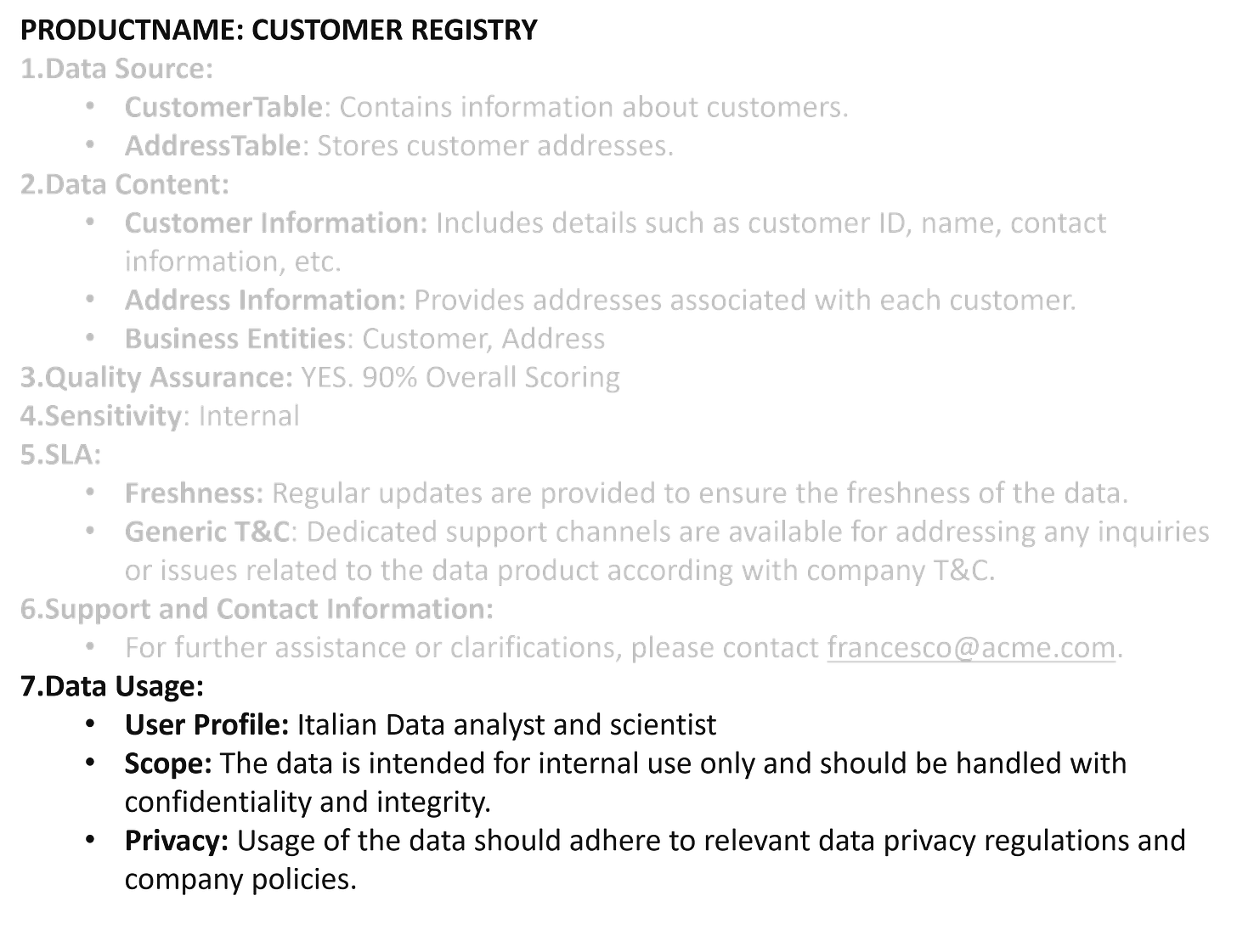
The preceding information should be sufficient for publication on a generic marketplace. Once published on the marketplace, it's necessary to define the access possibilities. The first check to perform is what the company policies are for "internal" data (information that we have included in the first component of the contract). Assuming, therefore, that our company is not particularly restrictive and allows usage by the entire internal user base, we could have different cones on our marketplace for roles:
- Data Analyst
- Data Scientist
- Business User
and for organizational units
- Users from the same department
- Users from the same region
- All employees
- By invitation only
These valuations obviously have aspects that can be further explored (in terms of scope and cost model), but it's decided that the dataset can be requested by "data analysts" and "data scientists" belonging to our same region (for example, Italy). We thus obtain the following enrichment.
Step 2️: Design Output Ports / Delivery Mode
Once the data product and its audience have been defined, it's necessary to establish the access methods to the same. Obviously, the components can vary greatly depending on the architectural aspects, but we can assume that the following methods have been defined:
For Data Analysts & Business Users:
- Provisioning in the reporting workspace.
For Data Scientists:
- Read-only access to the structures.
- Provisioning in the AI workspace (e.g., datalake + python).
Having selected both data scientists and data analysts in the previous section as potential users, there should be a constraint to select at least one output port per type. This way, it is decided to eliminate read-only access (for example, due to workload or access cost reasons). The contract would then appear as follows:
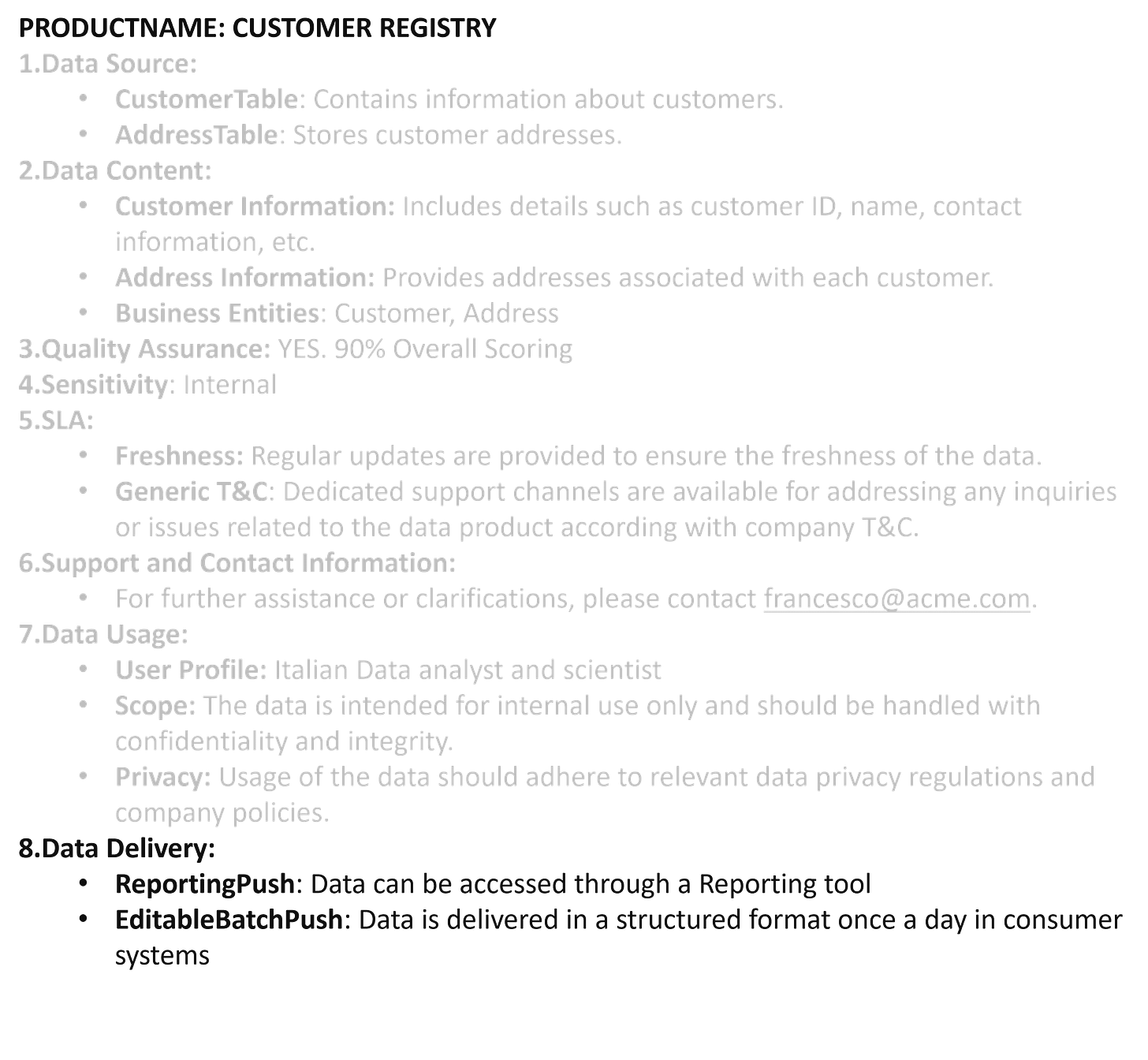
In the example, the possibility of applying filters or local authorizations was not explicitly stated, but the system accommodates the profiling mentioned above. Therefore, users would have the option, depending on their role, to access only one mode of utilization (reporting for data analysts, lake for data scientists).
All other categories, such as non-Italian users, external users, and business analysts, would see the product on the marketplace but would not be able to access it (not even in the preview).
Step 3️: Certify
To better understand the journey of building a data product, in our example, we have included the simple case where the data product owner (DPO) or data product manager is equivalent to the data owner of all entities, and there are no complex validation paths due to the sensitivity level of the data. It is therefore reasonable to assume that the publication is self-approving, and there are no validation steps in this stage of building a data product.
Step 4️: Monitor & Improve
Once the data product is published and made accessible/searchable, it should receive requests for usage (here, it needs to be evaluated whether they are automatically approved or not) and become an active member of the data economy. Therefore, DPOs must keep the products alive in the solution, evolve them, and manage them like any other asset under their responsibility.
Some of the evolutions could include:
- Including the "addressqueue" in our data product.
- Enhancing the level of data quality.
- Enriching the record schema.
- Offering services on the data product.
- Increasing/decreasing support SLAs (Service Level Agreements).
🔏 Author Connect

Connect with a community data expert
A no-cost session with a practitioner who's been where you are.
About Modern Data 101
Modern Data 101 is a movement redefining how the world thinks about data. A community built by the same team behind the world’s first data operating system, Modern Data 101 sits at the intersection of data, product thinking, and AI. Spread across 150+ countries, the community brings together a global network of practitioners, architects, and leaders who are actively building the next generation of data systems.
At its core, Modern Data 101 exists to simplify the journey from raw data to tangible and observable impact. It advocates high-potential data systems and next-gen architectures to unify and activate insights and automation across analytics, applications, and operational workflows at the edge.
In a world shifting from data stacks to AI ecosystems, Modern Data 101 helps teams not just navigate the change but lead it.


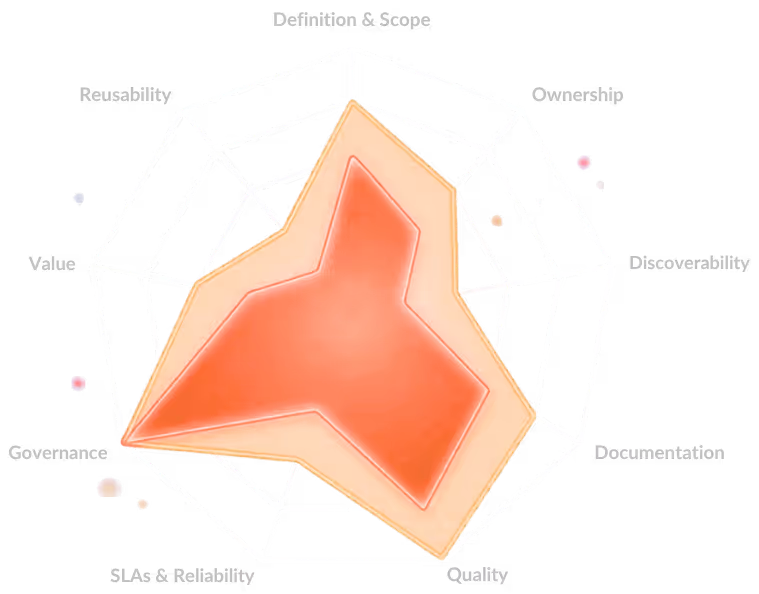
Where does your org stand on data product maturity?
A 9-dimension self-assessment used by 100+ data teams to benchmark strategy, ownership, and platform readiness.


Francesco De Cassai
Francesco’s expertise lies in crafting scalable data architectures that enhance data storage, retrieval, and processing along with a passion to explore new data management trends that help find new ways to capitalize on data value, such as Data Space and Governance.

Read the ideas here. Build them with The Modern Data Company.
Modern Data 101 is where the data community thinks out loud. When you're ready to move from articles to architecture, data products, governed AI pipelines, or a full Data Operating System; the team behind this community can help you build it.
Continue reading