

Building Truly Data Driven Organizations
Vinamra Vikram Vishen shares his perspective on data maturity, organizational transformation, shadow data, and building operating models that connect intelligence directly to business outcomes.

Power Questions
Min Read
Domains Covered
Published
Vinamra Vikram Vishen is a Chief Data Officer and business-first data leader who helps organizations transform through data, AI, and trust. With extensive experience spanning financial services, asset management, digital media, and customer analytics, he has led large-scale data and AI initiatives at organizations including Kotak Mutual Fund, Bandhan AMC, American Express, and ZEE. His work focuses on translating data, analytics, and emerging technologies into measurable business outcomes while maintaining strong governance, privacy, and regulatory alignment.
Currently serving as Chief Data Officer at Kotak Mutual Fund, Vinamra leads enterprise data, AI, governance, and data protection initiatives, helping shape the organization's data-driven future. He is recognized for building high-performing teams, driving enterprise transformation, and operationalizing intelligence responsibly in highly regulated environments.
A frequent industry speaker, panelist, and thought leader, Vinamra actively contributes to conversations around data strategy, AI adoption, digital transformation, and responsible innovation. We’re thrilled to feature his insights on Modern Data 101.
Vinamra Vikram Vishen explores what defines a truly mature data organization, how to drive adoption without organizational fatigue, and how operating models, governance, and culture can turn intelligence into measurable business outcomes.
How do you define the “Maturity” of a data organisation beyond just the complexity of the tech stack?
I think organisations often confuse their technology or tool stack maturity with their data maturity.
For me, the real question is not how sophisticated the tech stack is, but how deeply data and intelligence are connected to business strategy, workflows, decision making, and measurable outcomes.
Maturity starts at the strategic layer [ways of being]
- Does the organisation have a clear data strategy that is directly connected to business strategy? Is there clarity on which decisions data informs, which decisions it leads, and which decisions it can eventually drive?
The next layer is stewardship [ways of working and governance]
- Not governance as a control exercise alone, but stewardship models that create shared ownership between business and data teams. Mature organisations move away from isolated analytics functions toward interconnected teams operating through shared charters, pods, KPIs, and customer outcomes.
The third layer is workflow integration [ways of doing]
- In less mature organisations, intelligence often remains trapped inside dashboards and reporting environments. Mature organisations embed intelligence directly into operational workflows and decision systems.
- For example, instead of asking relationship managers to interpret multiple dashboards separately, intelligence should help prioritise customer engagement, surface context, recommend next best actions, and support decisions directly within the workflow itself.
Another important dimension is outcome orientation.
A mature data organisation should be able to connect the metrics it moves to actual business outcomes: revenue growth, CX improvement, risk mitigation,cost optimization or productivity enhancement etc
I also think maturity reflects the mindset of the data teams themselves.
Many teams still operate in an output-oriented model: dashboards delivered , models deployed, pipelines created etc. But mature teams increasingly think in terms of adoption and outcomes.Outcome focus is business essential. And,adoption is often a leading indicator of future outcomes, a directionality test of data products.
They obsess over whether intelligence is actually being used, whether behaviours are changing, and whether workflows are improving. Because without adoption, business impact rarely scales.
That also requires continuous experimentation, learning, agility, and strong product thinking around data.
Ultimately, mature organisations are not defined by how much data they produce or how advanced their AI stack is. They are defined by how consistently intelligence improves decisions, behaviours, and business outcomes at scale.
In your experience, what is the most effective way to transition a company from “Data-Aware” to “Data-Driven” without causing organisational fatigue?
One of the biggest misconceptions is that organisations should try to become fully data-driven everywhere at the same time.
- Mature organisations understand that different decisions require different levels of intelligence, oversight, and automation. Some decisions should remain data-informed, some become data-led, and only a subset should eventually become operationally data-driven.
- Transformation usually fails when it becomes additive instead of simplifying. If employees suddenly have more dashboards, more governance layers, and more reporting processes without operating more effectively, fatigue and resistance naturally follow.
- That is why successful organisations focus first on a few high-value workflows [churn arrest or CAC reduction or productivity boosters] where intelligence can create visible business leverage
The goal is not to transform everything simultaneously. It is to create measurable impact in a few critical areas , learn from it, improve adoption, and then scale progressively. This is particularly useful for companies who have just started their journey on this path vs venturing directly into a large scale transformation commitment.
Once teams see workflows becoming simpler, decisions becoming faster, and outcomes improving, adoption spreads far more organically across the organisation
Ultimately, successful transformation is not about deploying more AI or dashboards. It is about making the organisation measurably simpler, smarter, and more effective to operate.
How do you manage the "Shadow Data" problem viz where business units build their own silos because the central data team is perceived as too slow?
Shadow data is rarely a technology problem; it is typically an organisational response to gaps in trust, speed, ownership, or governance.
I don't manage shadow data by shutting it down. I manage it by understanding what organizational gap created it, then redesigning the structure, behaviors, and incentives that made shadow data the easiest path for the business
I don't manage shadow data by shutting it down. I manage it by understanding what organizational gap created it, then redesigning the structure, behaviors, and incentives that made shadow data the easiest path for the business
The root causes are usually structural, behavioral, cultural (read: incentives)
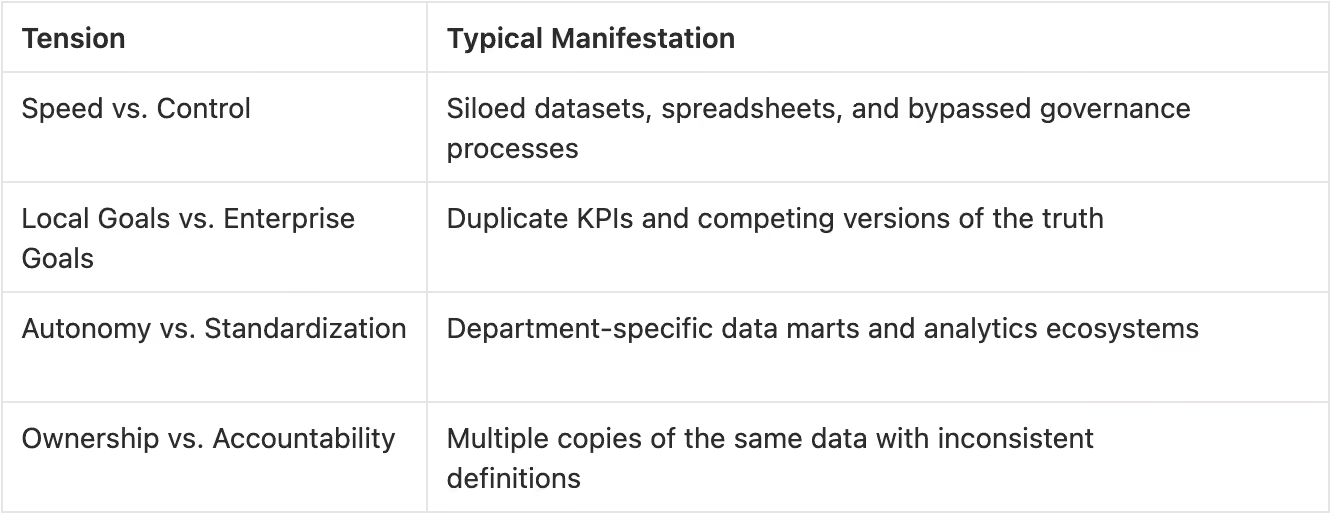
How the Problem Manifests
Four tensions typically drive shadow data:
Root Causes
These tensions generally originate from one or more failure points within either the central data function or the business.
Central Data Function
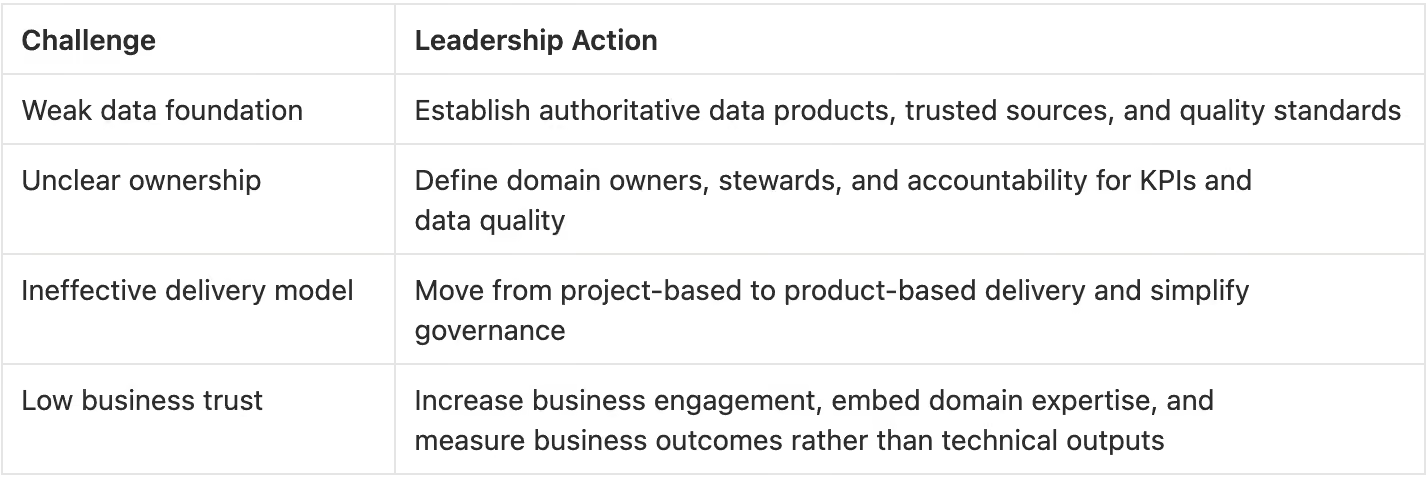
- Weak data foundation – No trusted, governed platform or single source of truth.
- Unclear domain ownership – Ambiguous accountability for metrics, data products, and quality.
- Ineffective delivery model – Slow execution, resource constraints, excessive centralization, or over-governance.
- Low business trust – Limited domain expertise, poor stakeholder engagement, and misaligned priorities.
Business Functions
- Speed prioritized over governance – Teams optimize for immediate outcomes and local execution.
- Misaligned incentives – Data teams are measured on governance and stability while business teams are measured on growth and results.
- Demand for autonomy – Mature domains seek greater control over their data and decision-making.
- Resistance to standardization – Governance is perceived as bureaucracy rather than an enabler.
Solving the Problem
Shadow data is best addressed through three levers: Structure, Behavior, and Incentives.
1. Structure: Align the Operating Model to Organisational Maturity
The objective is not to eliminate shadow data, but to understand what it is signaling about the organisation's operating model.I assess two dimensions:
Data Platform Maturity
- Governance and data quality
- Metadata management
- Self-service capabilities
- Trusted data foundation and common standards
Domain Maturity
- Business accountability
- Data literacy
- Analytical capability
- Ownership of business outcomes and KPIs
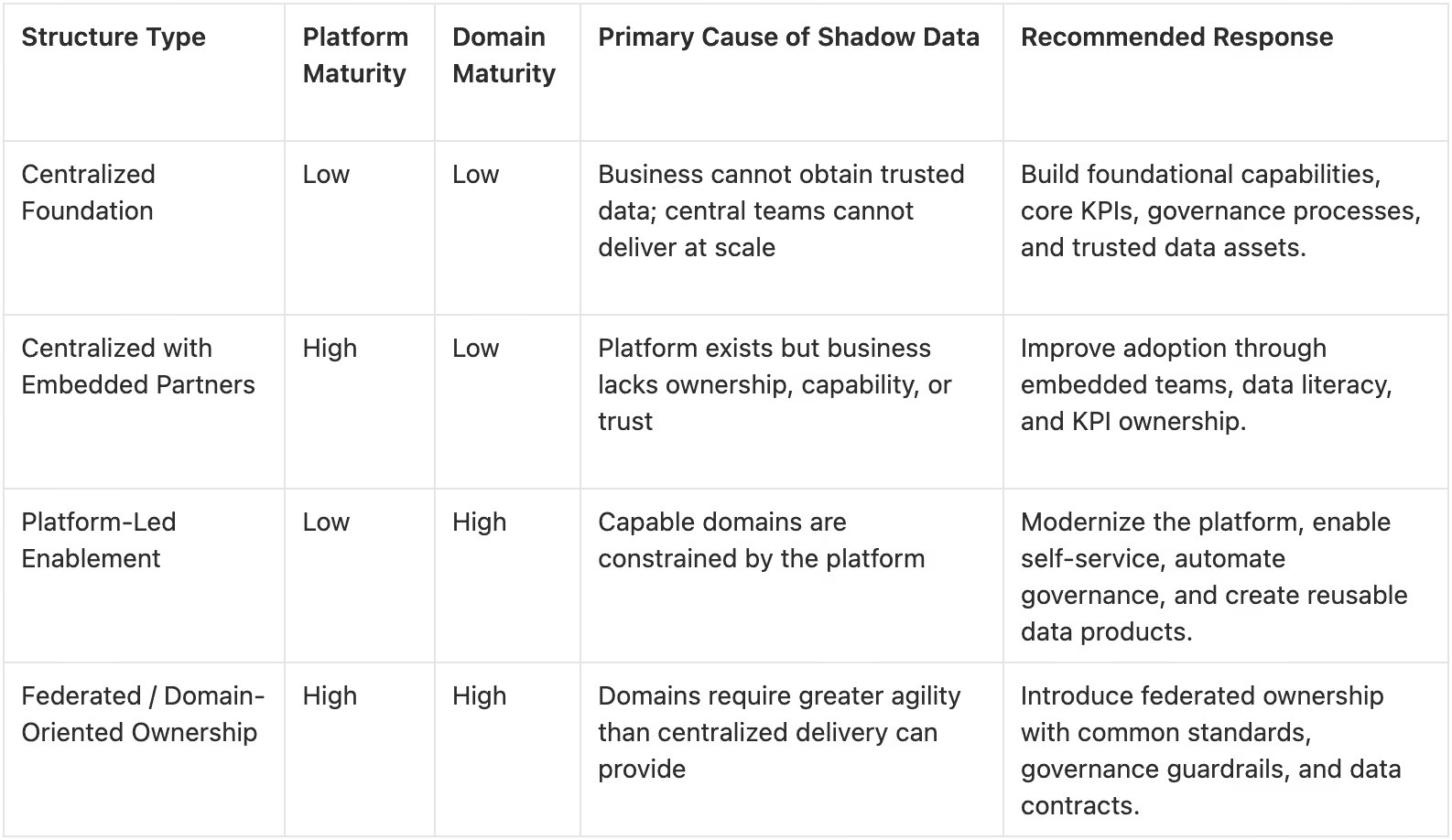
A key principle is that federation is not the objective, the objective is a fit-for-purpose operating model.
When platform maturity is high but domain maturity is low, creating domain data teams often increases cost and fragmentation. The better solution is enablement through embedded teams and stronger business ownership.
Conversely, when both platform and domain maturity are high, excessive centralization becomes a bottleneck.This works best when technology standards and platform decisions remain centralised; otherwise, tool sprawl often becomes an unintended consequence.
Decentralization creates speed only when trust remains centralized through shared platforms, standards, governance, and technology guardrails.
2. Behavior: Strengthen the Central Data Function
Even with the right structure, shadow data will persist if the central data organisation is not trusted.
3. Incentives: Align What Gets Rewarded (Read: Data Culture)
Many shadow data problems are incentive problems disguised as technology problems. Common examples include:
- Business teams are rewarded for speed while data teams are rewarded for governance.
- Local leaders measured on functional outcomes rather than enterprise consistency.
- Success metrics focused on delivery volume rather than adoption and business impact.
To address this:
- Create shared business-data objectives.
- Measure data product adoption and trust.
- Hold domains accountable for data quality.
- Reward reuse of enterprise assets rather than creation of local alternatives.
Bottom line Shadow data is often not a technology failure; it is feedback on the operating model. Sustainable success comes from aligning structure, behaviour, and incentives so that the governed path is also the fastest and most trusted path for the business. When that happens, shadow data naturally declines because teams no longer need to work around the system to achieve outcomes
More Visionary Spotlights
.png)
.avif)
.avif)
Want to be featured in a Visionary Spotlight?
We interview C-suite leaders shaping the future of data, AI and analytics. If that's you, or someone you know, get in touch.